
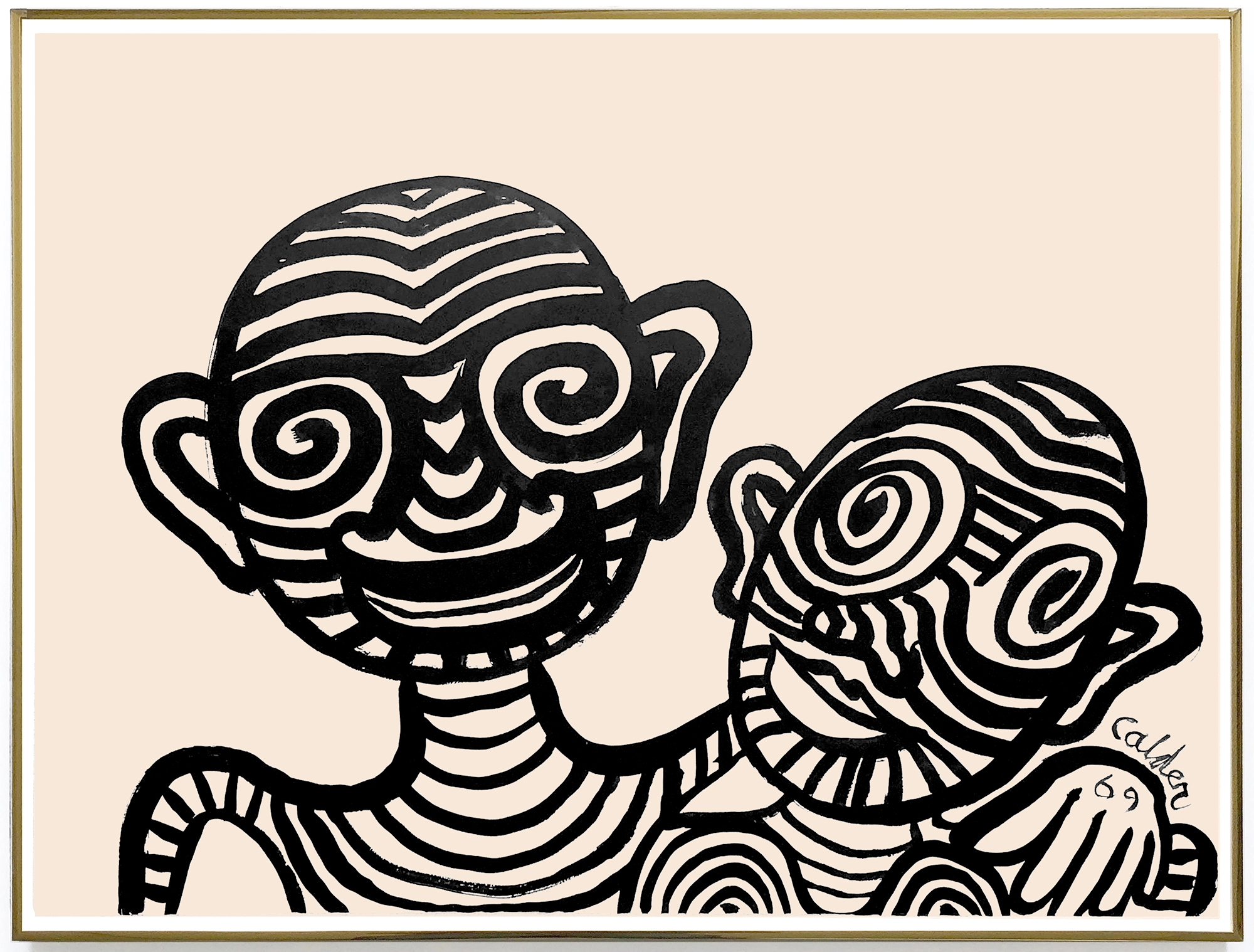
Boys and Girls, 1969
paper: 22 5/8 x 30 1/2 inches
frame: 24 x 32 inches
Signed and dated 69 lower right
Accompanied with Perls Galleries Photo Certificate #9753/P5701
Provenance
Perls Galleries, New York
Collection of Renate & Sidney Shapiro, New York
Private Collection, New York
Additional Photos
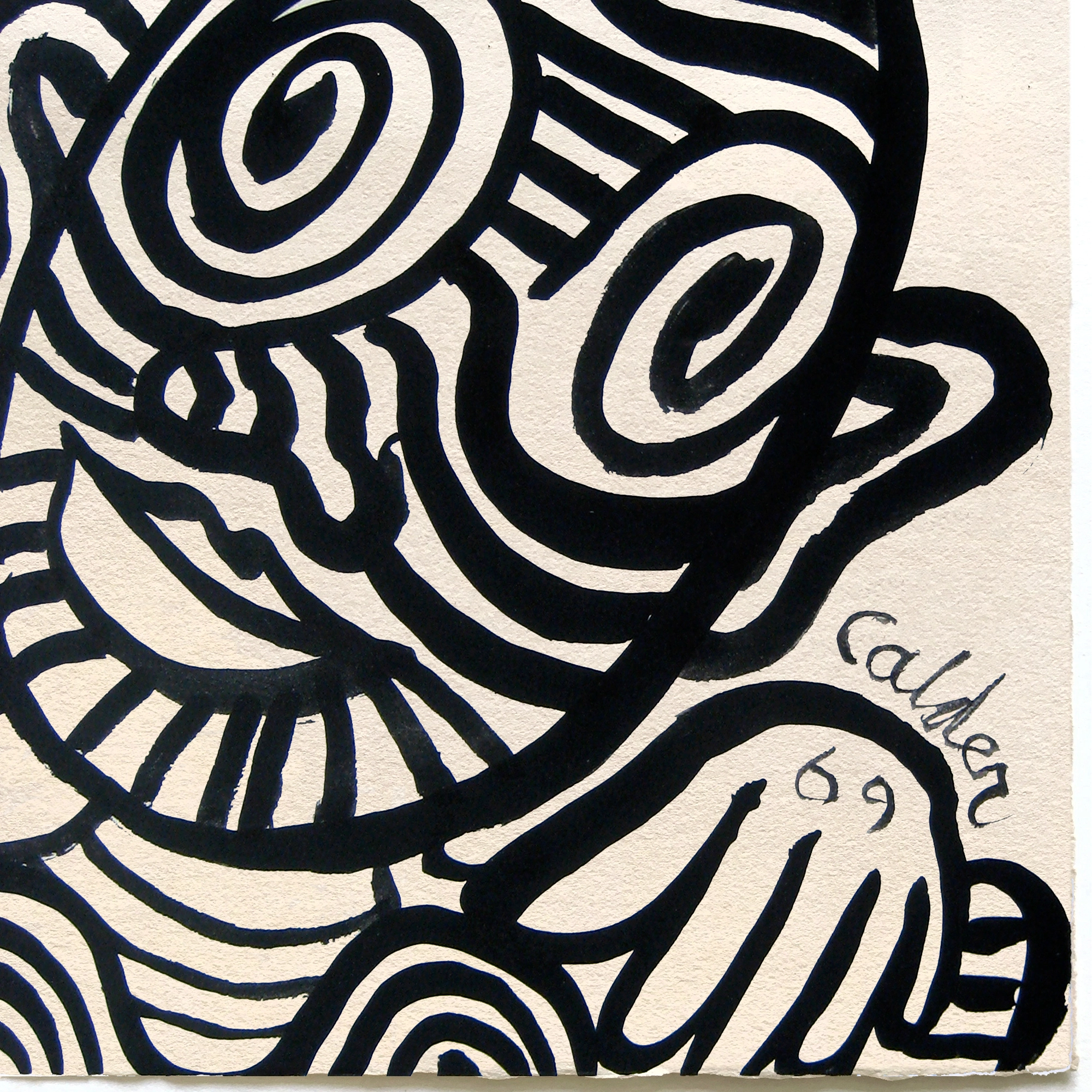
Signature & Date lower right
In 1945, the Kootz Gallery presented Alexander Calder’s first solo exhibition of gouaches—works on paper—in a show titled “ Gay, Fantastic Gouaches by Calder ” The exhibition was well received by critics, who identified Calder as a potential rival to artists such as Paul Klee and Joan Miró.
ALEXANDER CALDER: INFLUENCE OF AFRICAN & OCEANIC ART
In 1945, the Kootz Gallery presented Alexander Calder’s first solo exhibition of gouaches — works on paper — in a show titled “ Gay, Fantastic Gouaches by Calder ”. The exhibition was well received by critics, who identified Calder as a potential rival to artists such as Paul Klee and Joan Miró.
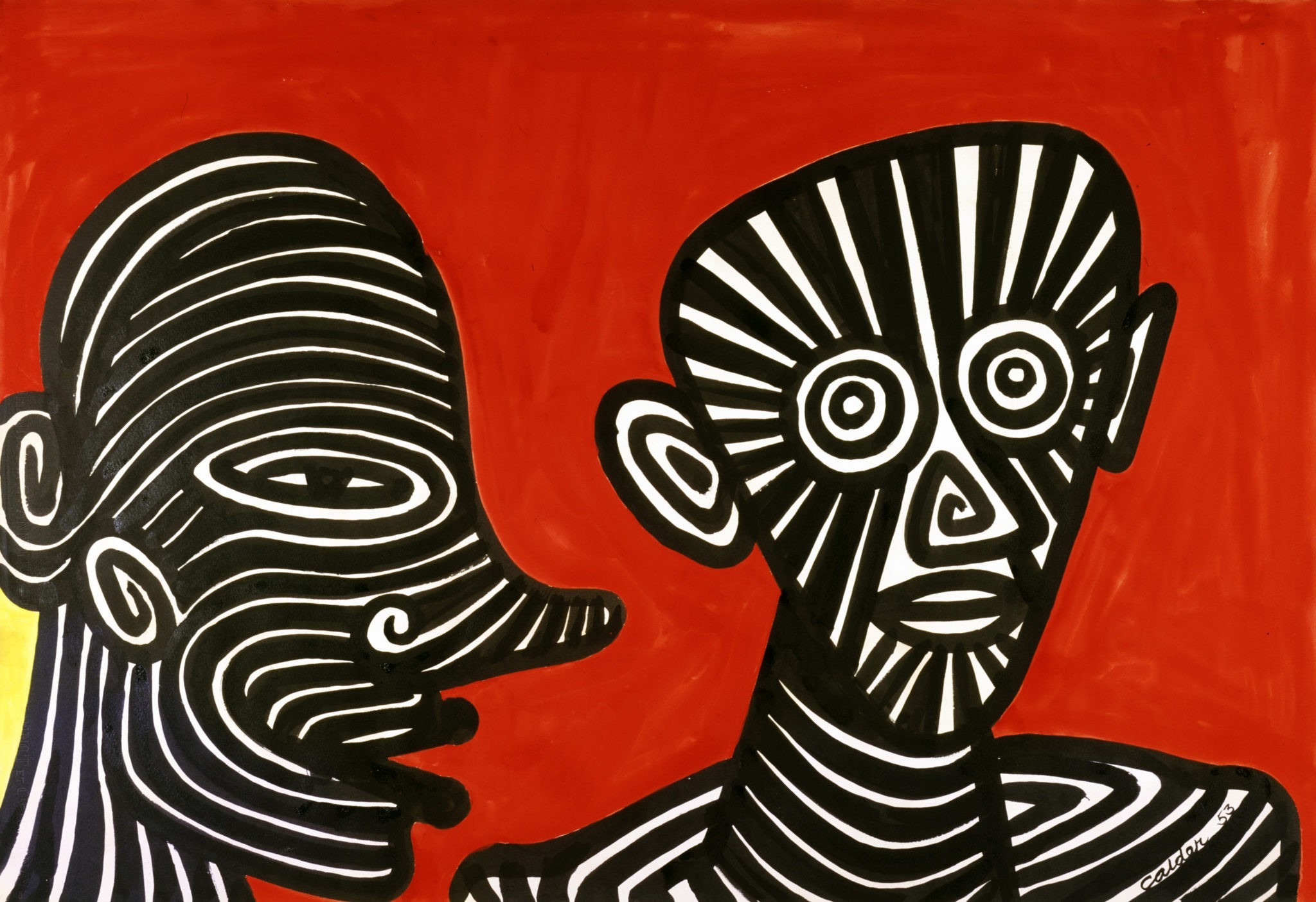
Untitled , 1953
Calder Foundation, New York
Although best known for revolutionizing sculpture with his mobiles and stabiles, Calder’s gouaches represent a parallel artistic inquiry that synthesizes *painterly immediacy* with his sculptural vocabulary. These works were built out of *bold, pulsating colour and fluid line* with a freedom that reflects both the spontaneity of drawing and the intensity of his three‑dimensional models. Critics have observed that in the gouaches, shapes that recall spirals, circles, and abstract biomorphs carry over the same visual wit and kinetic energy found in his mobiles.
Calder himself once remarked about his approach to creating works on paper: "What I produce is not precisely what I have in mind — but a sort of sketch, a man‑made approximation." This statement captures his belief that the viewer’s interpretation was as significant as his own intent in the making of a piece, and underscores his openness to the associative possibilities of line, color, and form.
Untitled , 1953
Calder Foundation, New York
Long before his career was defined by sculptural innovations, Calder experimented with drawing and painting, and his familiarity with diverse artistic traditions — including African and Oceanic objects he collected and displayed — informed the way he composed forms and motifs. During his early years in New York, Calder carved wooden sculptures influenced in part by his exposure to African and pre‑Columbian art, a connection that echoes through his elegant use of simplified geometry and rhythmic patterning.
Alexander Calder’s Boys and Girls, 1969, gouache on paper, exemplifies this synthesis of influences. The work’s abstract figures, spiraling elements, and simplified shapes reflect both an embracing of global visual languages and Calder’s own visual vocabulary. Comparable African‑influenced gouaches by Calder are held in major museum collections, including The National Gallery of Art in Washington, D.C., Saatchi Gallery in London, and Grand Rapids Art Museum in Michigan.
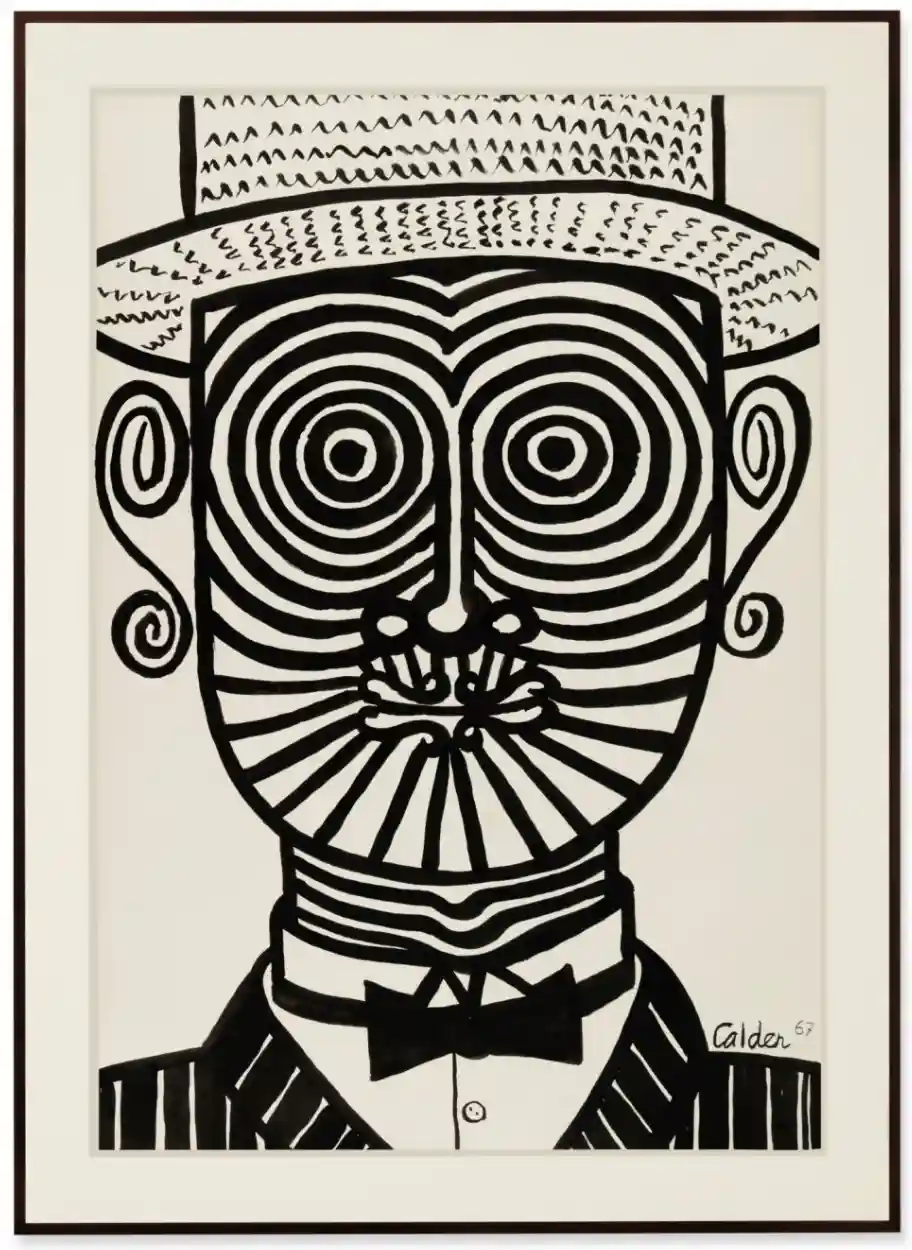
Le Buveur d’Eau, 1967
Chez Kay: Property from the Collection of Kay Unger
Sotheby’s, New York, May 13, 2021, Lot 203, $378,000 USD
In Boys and Girls, the artist incorporates the spiral — a visual motif that appears throughout his career in painting, sculpture, jewelry, and wire drawings — linking formal systems across media and suggesting both play and continuity. The simplified, vibrant figures also draw on a visual language attuned to the elemental and geometric modes found in African and Oceanic visual traditions, while retaining Calder’s characteristic humor and rhythmic balance.
#AlexanderCalder 1974 gouache on paper achieved astonishing $277.2K, eclipsing $40K-$60K pre-sale estimate @ChristiesInc NY, 11/22/2024.https://t.co/TZsGcbcf1X pic.twitter.com/Kqa2h4onrl
— Joseph K. Levene Fine Art, Ltd. (@JKLFA) November 22, 2024