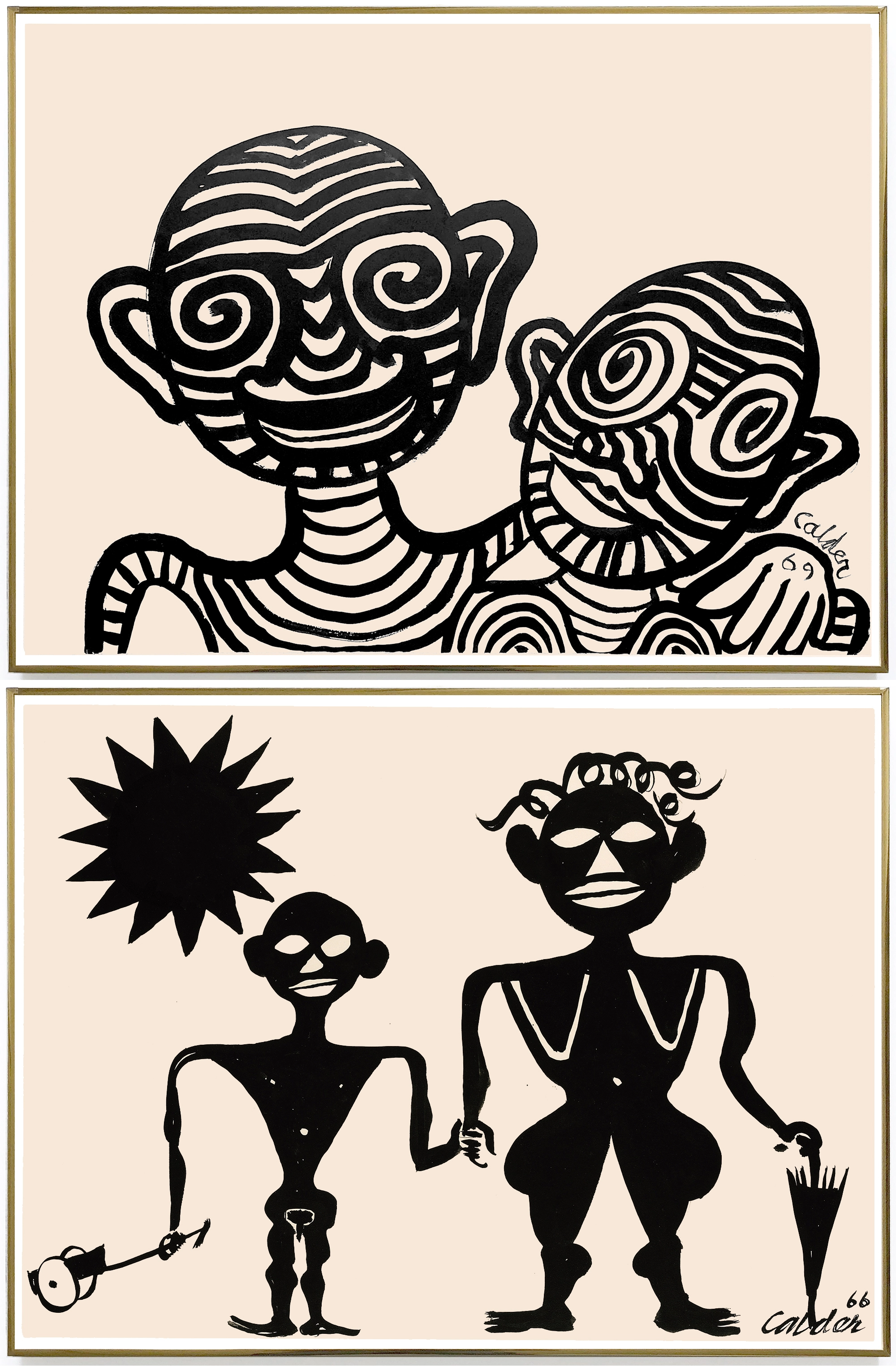

Boys and Girls, 1969
paper: 22 5/8 x 30 1/2 inches
frame: 24 x 32 inches
Signed and dated 69 lower right Accompanied with Perls Galleries Photo Certificate # 9753/P5701
Provenance
Perls Galleries, New York (Reference no. 9753/P5701)
Collection of Renate & Sidney Shapiro, New York
Private Collection, New York
African Scene, 1966
ink on paperpaper: 22 7/8 x 30 3/4 inches
frame: 24 x 32 inches
signed and dated 'Calder 66' (lower right) with Perls label No. 7747
This work is registered in the archives of the Calder Foundation, New York, under application number A05112.
Provenance
Perls Galleries, New York
Louise Ferrari, Houston
Private collection, Houston
Anon. sale; Christie's, New York, 9 November 1979, lot 22
The Arthur and Anita Kahn Collection: A New York Story, Christie's, New York, August 14, 2015
Private Collection, New York
Additional Photos
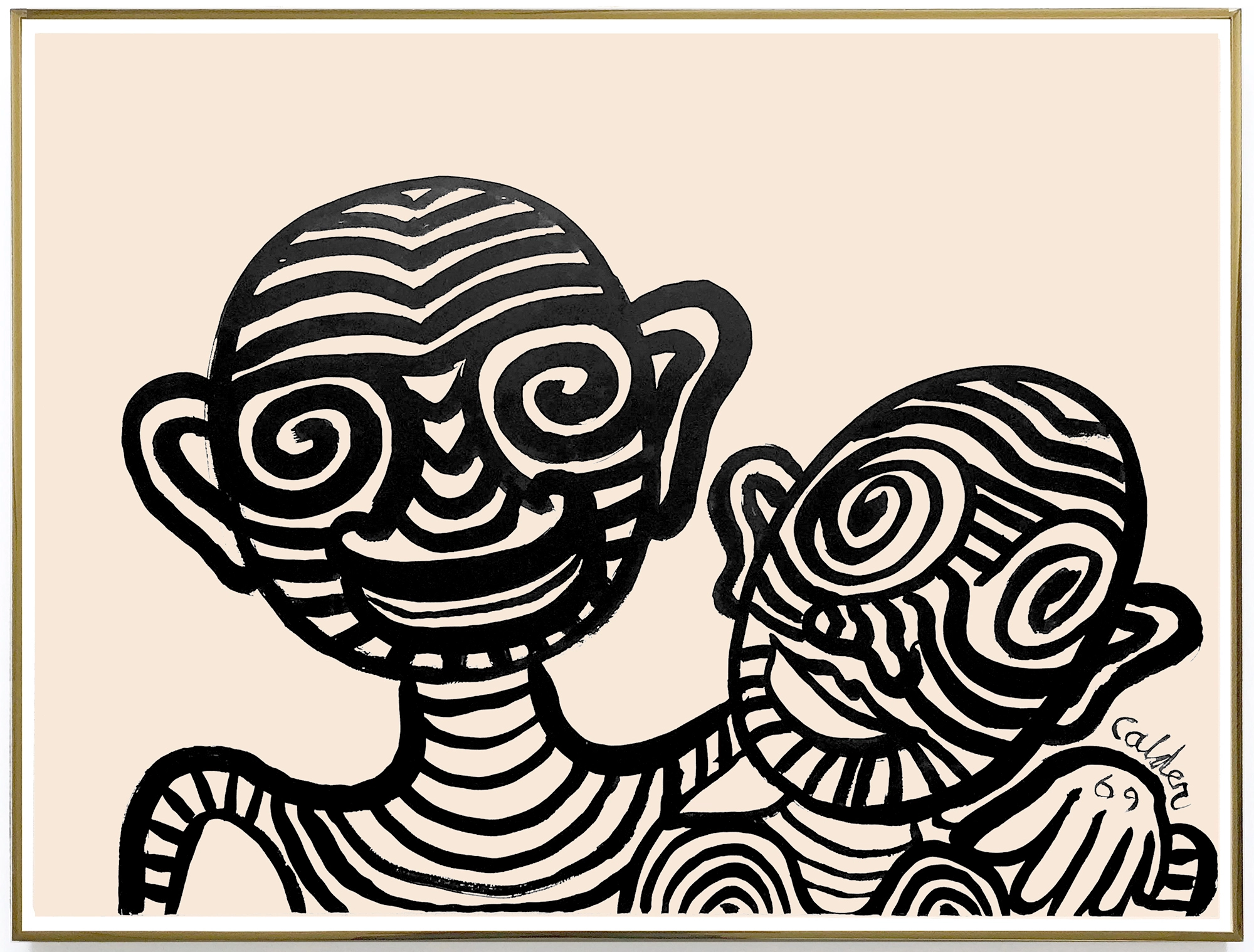
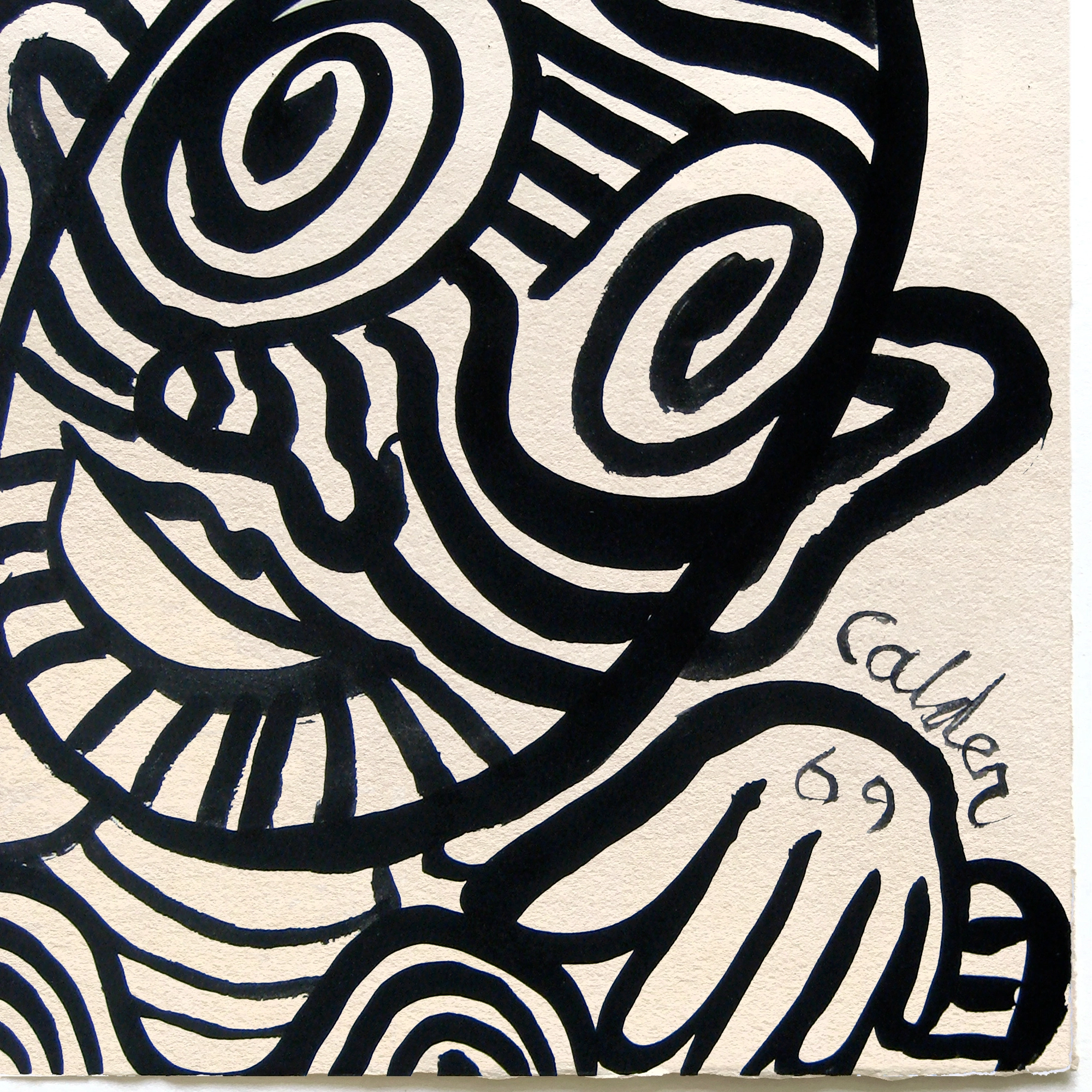
Signature & Date lower right


Signature & Date lower right
The circulation of ethnographic objects across Europe and North America impacted the international avant-garde, particularly the Surrealists, in various ways. While living in New York in 1928 Calder began to carve sculptures out of tropical woods, a direct carving technique influenced by his growing appreciation of African and pre-Columbian art.
ALEXANDER CALDER AFRICAN & OCEANIC ART INFLUENCE
The circulation of ethnographic objects across Europe and North America impacted the international avant-garde, particularly the Surrealists, in various ways. While living in New York in 1928 Calder began to carve sculptures out of tropical woods, a direct carving technique influenced by his growing appreciation of African and pre-Columbian art. Like Pablo Picasso, Henri Matisse and André Breton, before him, Calder collected and displayed African and Oceanic objects, and at certain points in his career, Calder’s works directly reference the style and subjects of these objects. In his homes, Calder frequently displayed his own works alongside his collection of African and Oceanic objects.
Boys and Girls and African scene both reference the spirals and crude forms of African and Oceanic art and represent some of Calder’s most iconic imagery from this series. Other drawings with similar motifs are in prominent Museum collections, including the National Gallery of Art, the Museum of Modern Art, the Art Institute of Chicago and the Whitney Museum of American Art.
This pair of Alexander Calder works on paper represent an important moment in Calder’s oeuvre. Made only 3 years apart, each references his fascination with family and African art/imagery. Calder repeatedly incorporated the spiral—a typical motif in late Bronze Age artifacts—into his paintings, as well as his wire figures, drawings, jewelry and other decorative arts.
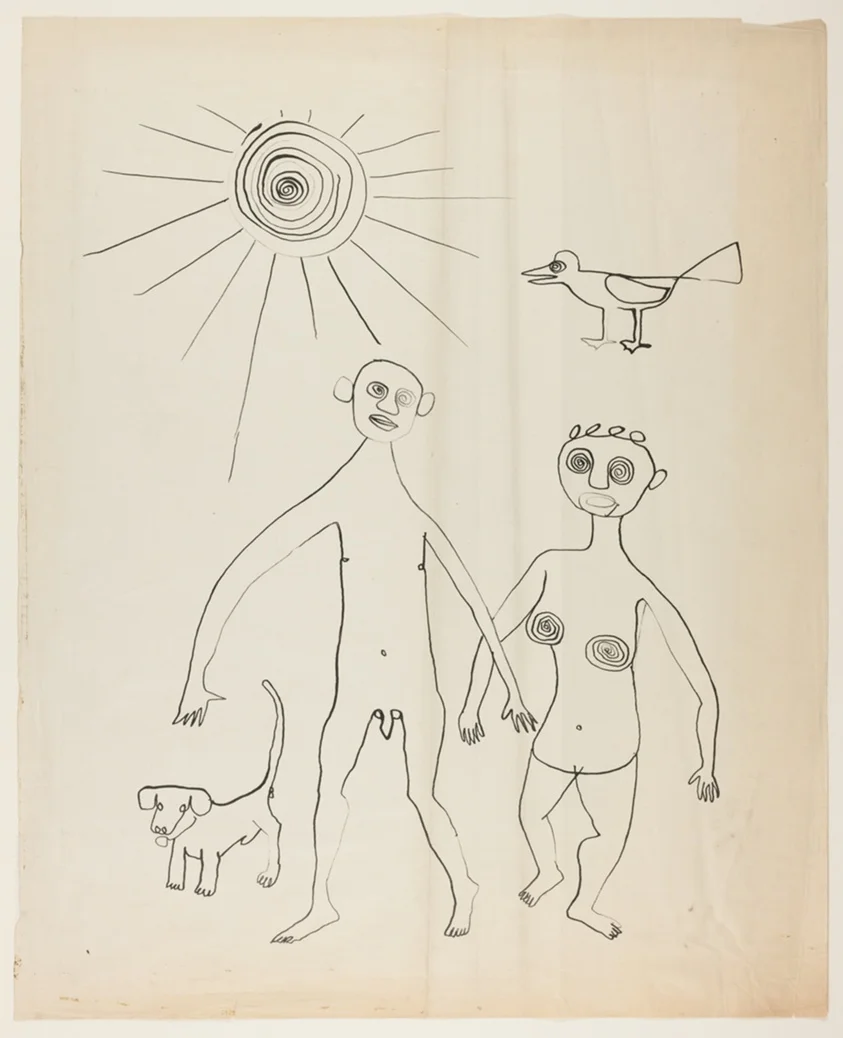
Man, Woman, Dog, Bird, Sun The Art Institute of Chicago
The artist's personal collections, which included objects from African, Oceanic and Pre-Columbian cultures, substantiate his eclectic taste. The spiral form and stripes borrowed from African art dominate Boys and Girls, while in African Scene, Calder incorporates African sculptural iconography and adds a touch of modern whimsy with the umbrella and cart to the nude African figures.
Inspired by African tribal art, #AlexanderCalder 1945 small gouache fetches $162,500 at #FreemansAuction, exceeding $50,000-$80,000 pre-sale estimate. https://t.co/tbPH9wijn8 pic.twitter.com/WXMwSB4W9N
— Joseph K. Levene Fine Art, Ltd. (@JKLFA) November 17, 2020