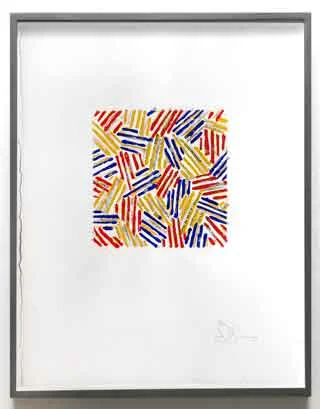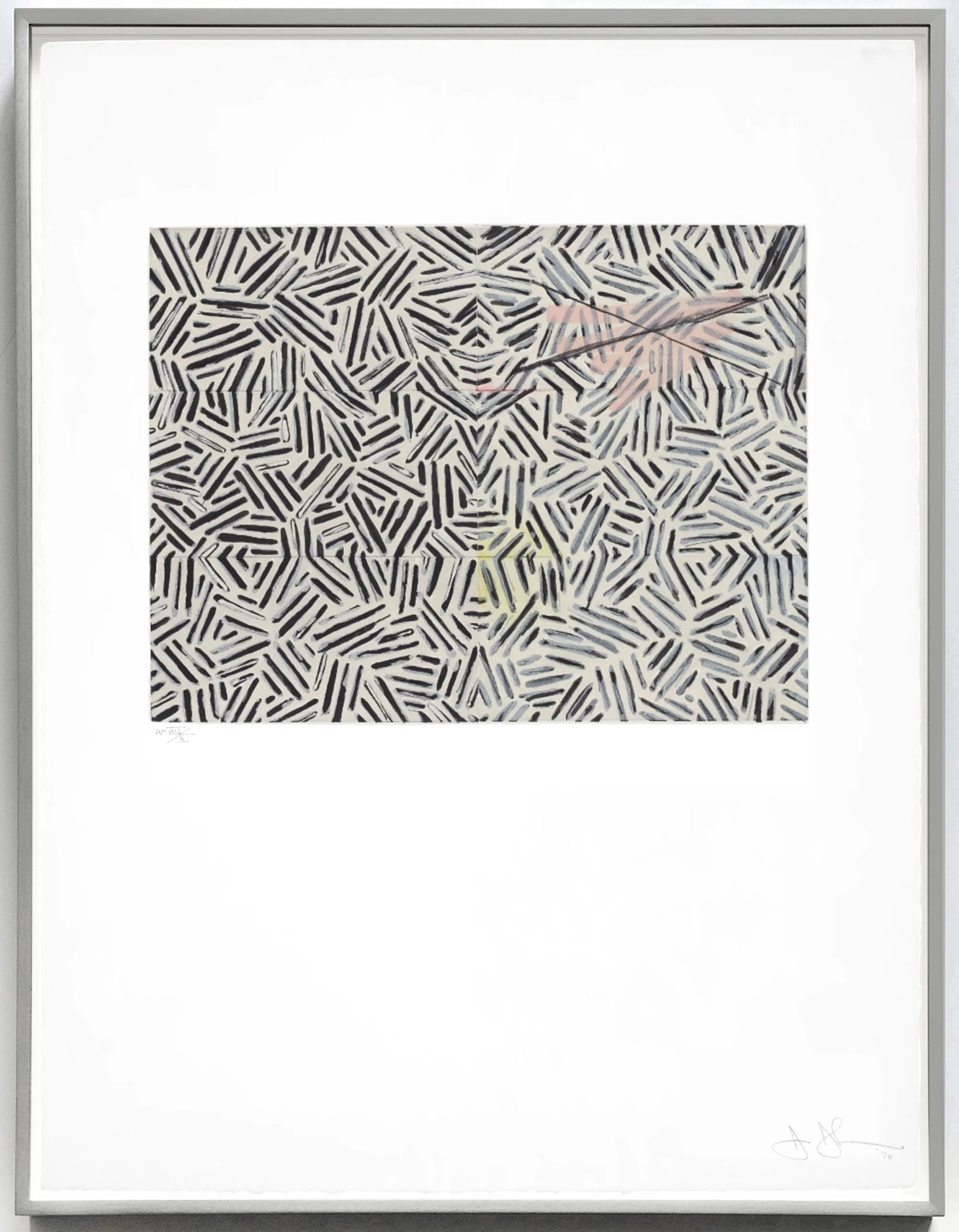

Corpse and Mirror
(ULAE 167), 1976
paper: 25 3/4 by 19 3/4 inches
image: 10 1/2 x 14 inches
frame: 26 1/2 x 20 6/8 inches
edition: 50 with 10 AP's & 2 PP's
signed & dated in pencil "J Johns '76" lower right
numbered in pencil lower left
printed by Atelier Crommelynck
published by Petersburg Press, 1976
© Jasper Johns / Licensed by VAGA at Artists Rights Society (ARS), NY
Literature
Richard Field, Jasper Johns Prints 1970-1977, Wesleyan University, Middletown, 1978, Catalogue Reference 209, p. 105, another impression reproduced in black and white.
Michel Butor, Kathleen Slavin, Jasper Johns Gravures Dessins 1960-1991, Foundation Vincent Van Gogh, 1992, no. 58, pg. 106, another impression reproduced in full-page color.
Richard Field, The Prints of Jasper Johns 1960-1993: A Catalogue Raisonne, ULAE, New York, 1994, Catalogue Reference ULAE 167, n.p., another impression reproduced in full-page black and white.
Exhibited
The Museum of Modern Art, New York, Recent Acquisitions: American Prints, November 16,1978–February 20, 1979, another impression exhibited.
The Museum of Modern Art, New York, Jasper Johns: A Print Retrospective, May 19, 1986–August 19, 1986, another impression exhibited.
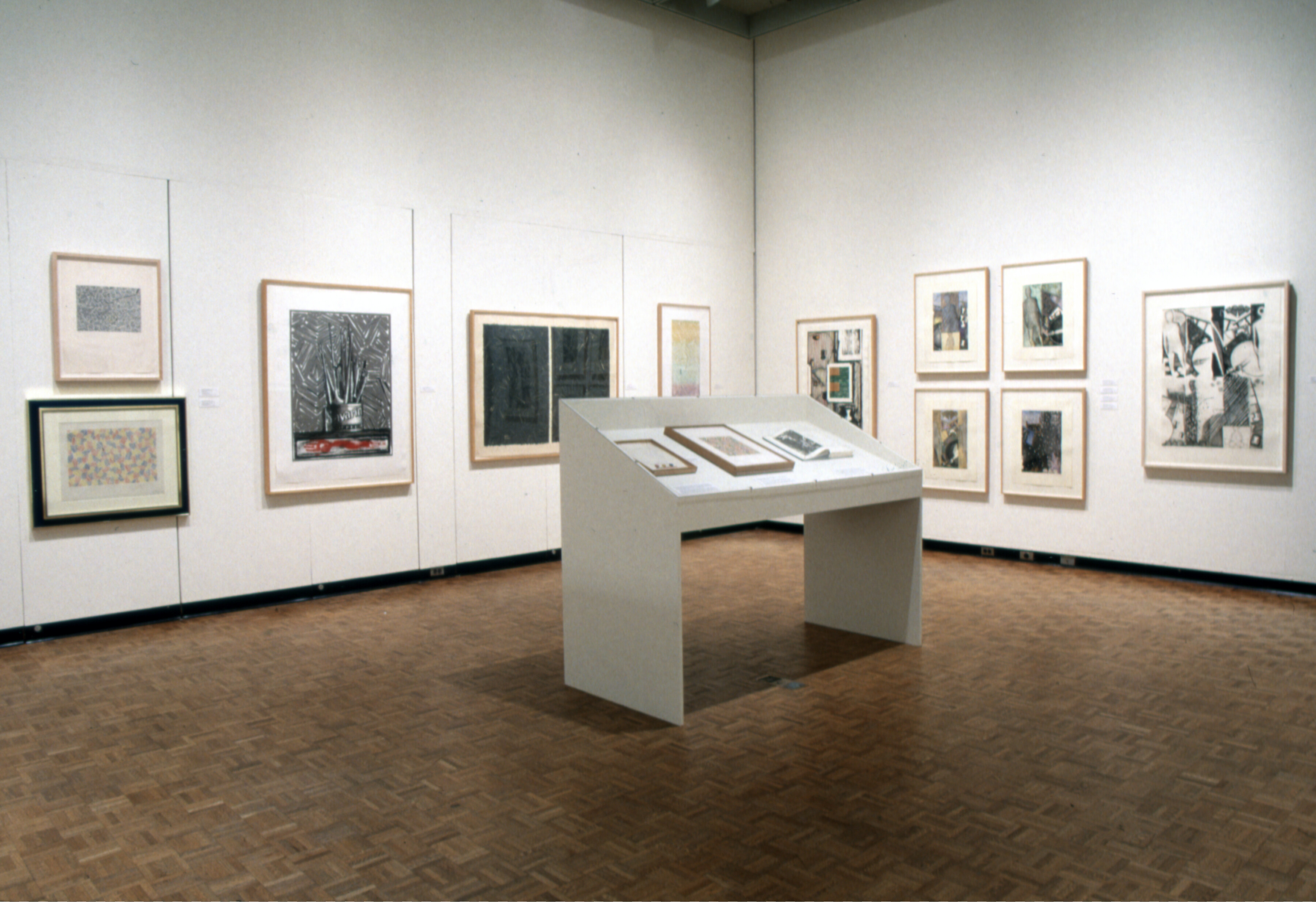
Milwaukee Art Museum, Milwaukee, Jasper Johns, Prints and Multiples, May 15, 1992-August 23, 1992, this impression exhibited.
Ackland Art Museum, University of North Carolina at Chapel Hill, Jasper Johns, Prints and Multiples, September 19, 1992-November 15, 1992, this impression exhibited.
University Art Gallery, State University of New York at Albany, Jasper Johns, Prints and Multiples, March 2, 1993-April, 23 1993, this impression exhibited,
The University of Lethbridge Art Gallery, Lethbridge, Alberta, Jasper Johns, Prints and Multiples, December 13, 1992-January 31, 1993, this impression exhibited.
The University of Wisconsin, Milwaukee, Modern Bias / Contemporary Viewpoints, February 22-February 22, 1996-March, 31, 1996, this impression exhibited.
Powers Art Center, Carbondale, Jasper Johns: a whole can be only a part, December 2, 2025 – October 31, 2026, another impression exhibited.
Selected Museum Collections
Walker Art Center, Minneapolis
National Gallery of Art, Australia
National Gallery of Art, Washington D.C.
John and Kimiko Powers, Powers Art Center, Carbondale
Additional Photos
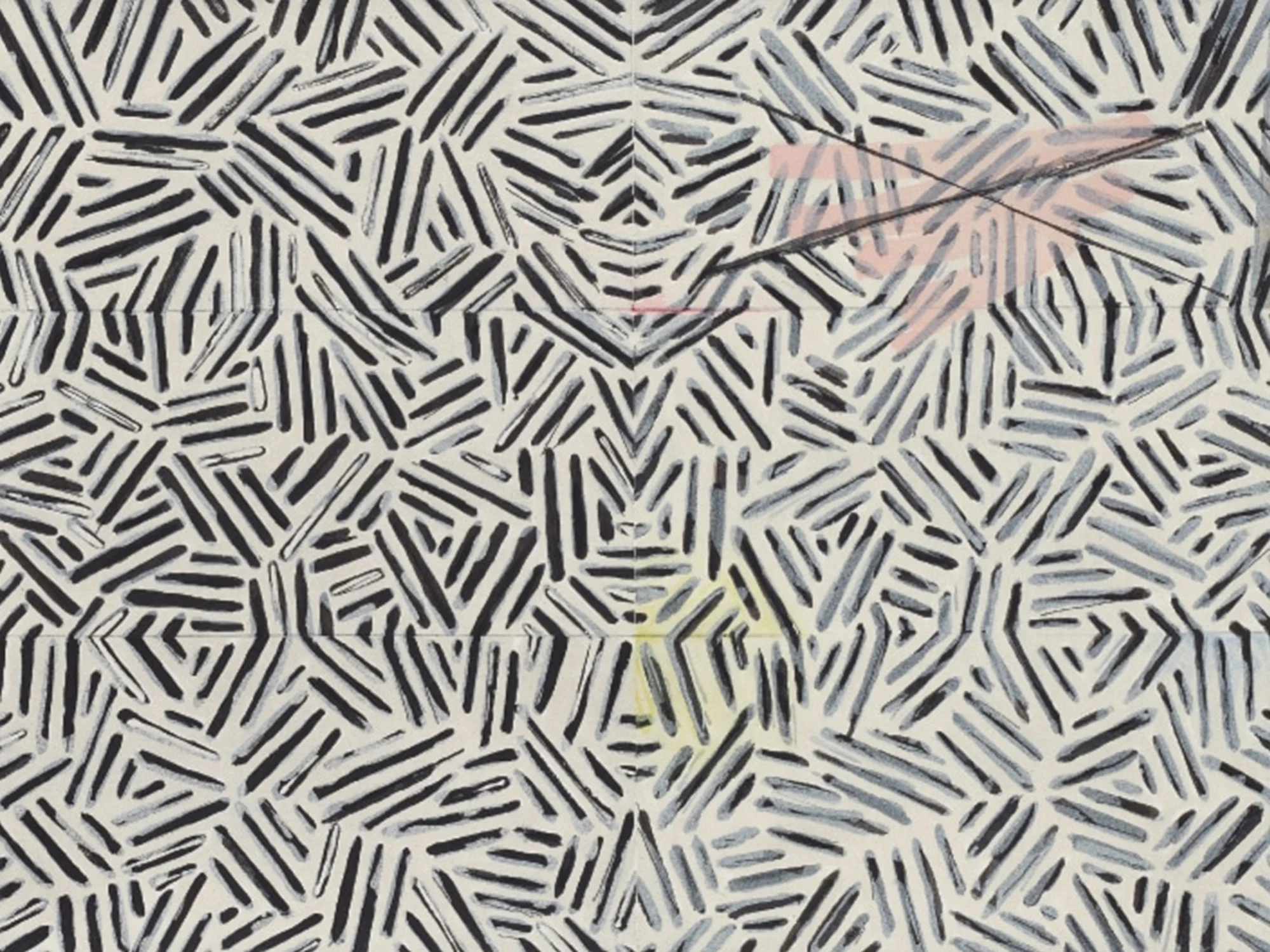
Image Detail
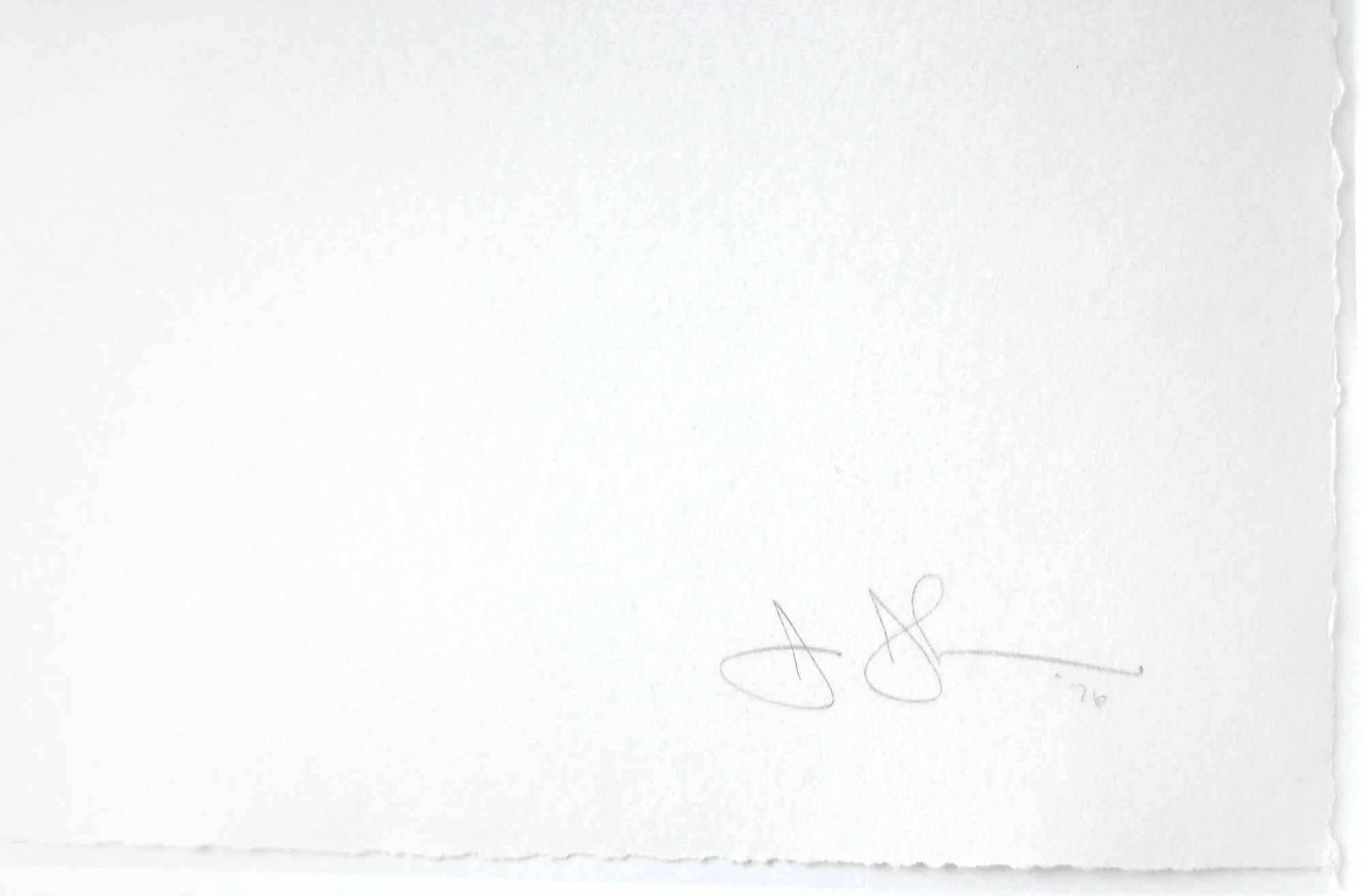
Signature & Date lower right
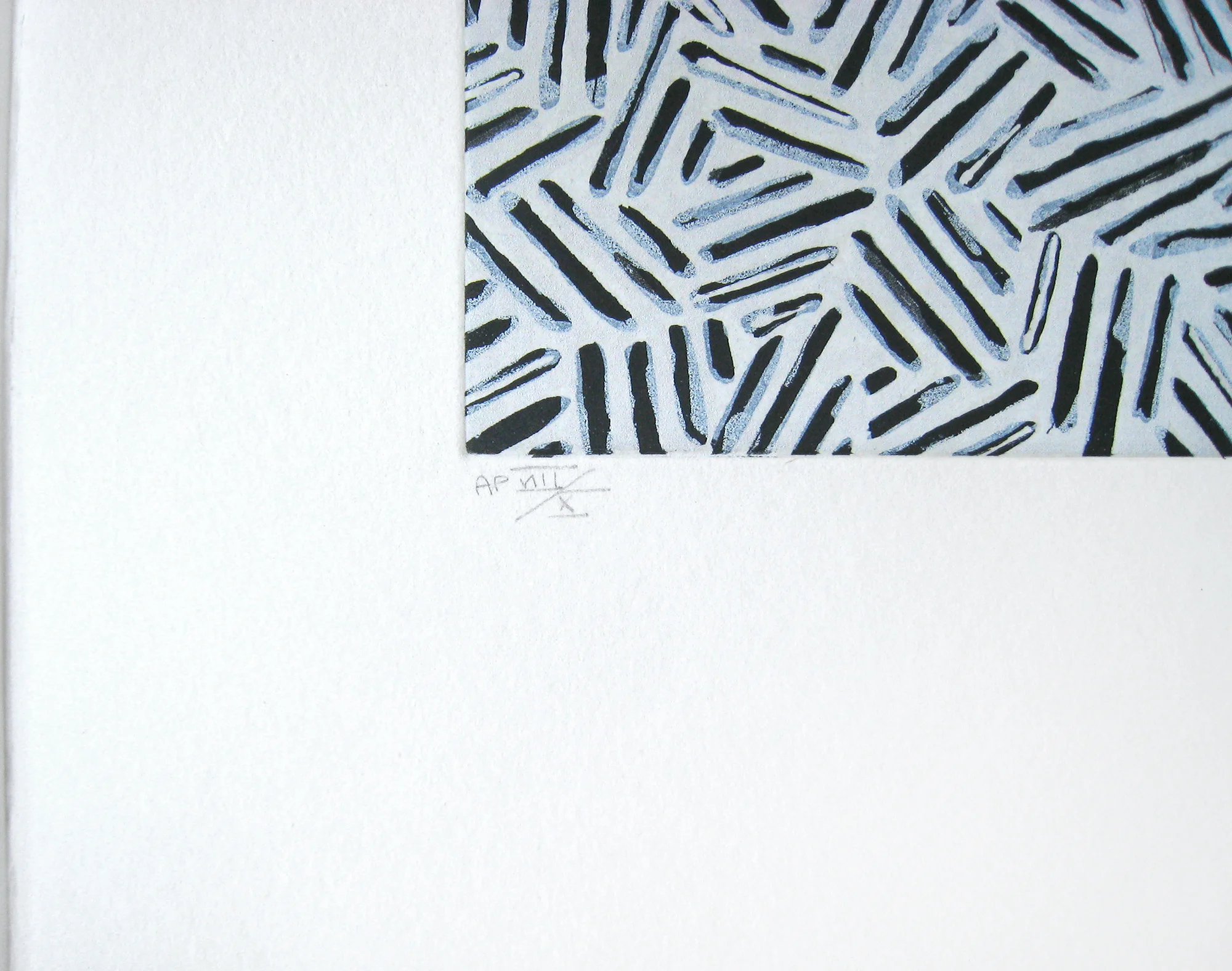
Edition number lower left
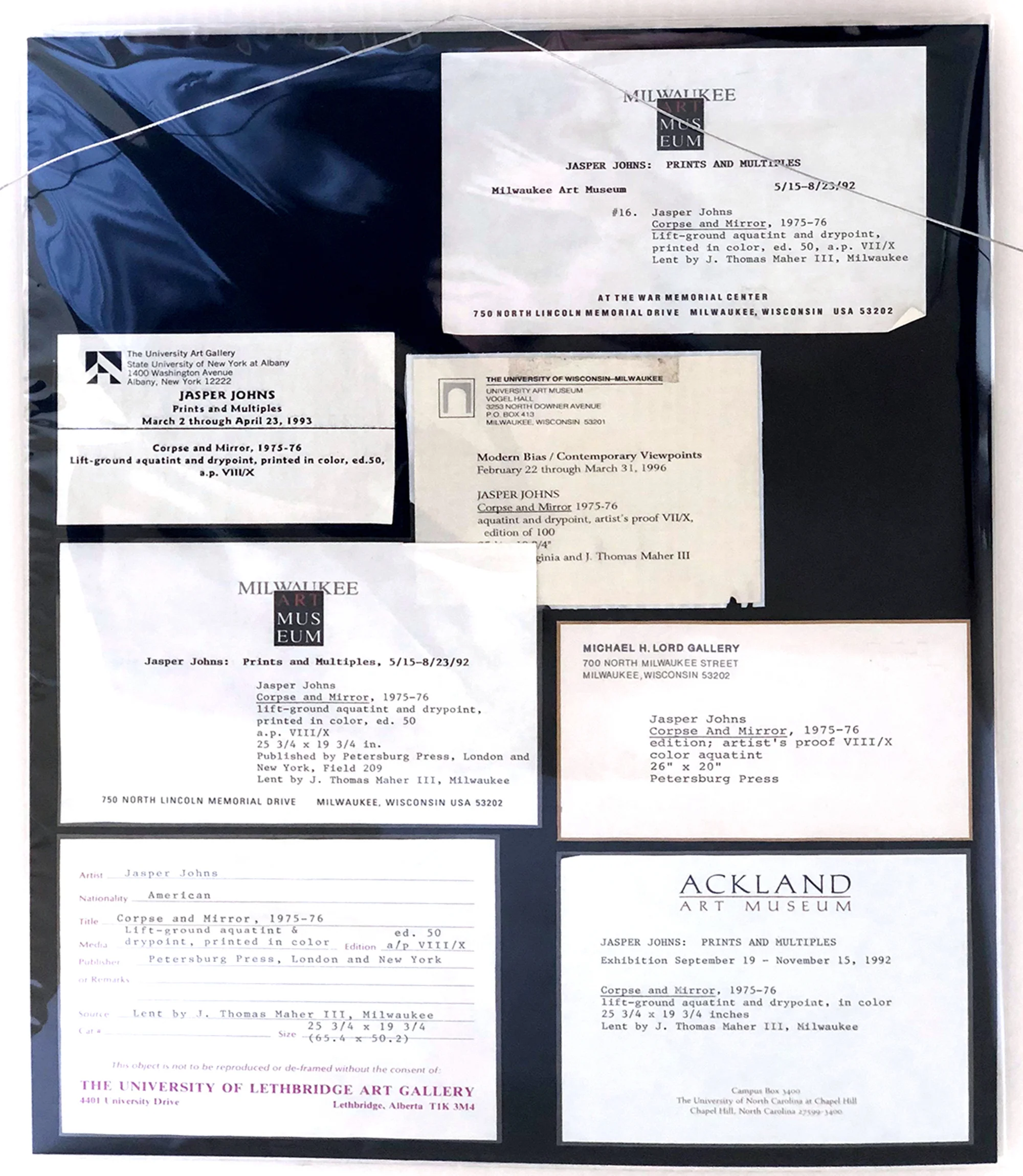
Museum Exhibition labels
Beginning with his 1972 painting Untitled, Jasper Johns developed the crosshatch motif, experimenting with color, pattern, mirroring, and reversal. According to Jasper Johns, the inspiration came from a pattern he glimpsed on a car passing on a highway: “I only saw it for a second, but knew immediately that I was going to use it. It had all the qualities that interest me – literalness, repetitiveness, an obsessive quality, order with dumbness and the possibility of a complete lack of meaning.” Over the following decade, Johns explored this motif in paintings, drawings, and prints, transforming an apparently simple arrangement of parallel lines into a complex investigation of visual perception.
JASPER JOHNS CORPSE & MIRROR
Beginning with his 1972 painting Untitled, Jasper Johns developed the crosshatch motif, experimenting with color, pattern, mirroring, and reversal. According to Jasper Johns, the inspiration came from a pattern he glimpsed on a car passing on a highway: “I only saw it for a second, but knew immediately that I was going to use it. It had all the qualities that interest me – literalness, repetitiveness, an obsessive quality, order with dumbness and the possibility of a complete lack of meaning.” Over the following decade, Johns explored this motif in paintings, drawings, and prints, transforming an apparently simple arrangement of parallel lines into a complex investigation of visual perception.
The painting Corpse and Mirror, 1974, on which this print is based, belongs to the early years of Johns’s crosshatch period (1973–83) and explicitly introduces the concept of mirroring. Although commonly described as crosshatching, the lines do not intersect in the conventional manner. Instead, they form clusters of parallel marks slanting diagonally in different directions. Crosshatching had long served artists and printmakers as a means of suggesting volume, depth, and shadow. Johns turned this established graphic device into the subject itself, exploring how repetition, direction, and color could organize a composition without necessarily conveying a recognizable image.
In Corpse and Mirror, the left and right sides of the composition mirror one another, each divided into three sections. A faint white veil over the sections on the right emphasizes the symmetry across the central seam while disrupting continuity at the interior edges. The result suggests the bilateral organization of the human body, while the title evokes both the corpse and its reflection. The divided composition also recalls the Surrealist game of Exquisite Corpse, in which participants draw separate sections of a figure without seeing the contributions of the others. Here, the parts appear to belong to a whole, yet their relationship remains deliberately unstable.
This tension between fragmentation and unity is central to Johns’s crosshatch works. As explored in Jasper Johns: A Whole Can Be Only a Part, the 2025–26 exhibition at the Powers Art Center, Johns repeatedly tested how an image could be divided, rearranged, and perceived anew. Repetition does not simply reinforce a single image; it produces differences between its constituent elements. Mirroring establishes an apparent order, while subtle variations in color, density, and direction prevent the composition from becoming entirely uniform. The whole is thus inseparable from its parts, but it is never merely their sum.
Throughout his career, Johns returned to familiar forms and motifs, examining how an idea changes when translated between painting, drawing, and printmaking. His graphic work was not simply an extension of his painting. The two practices informed one another, allowing him to investigate how the same compositional principles could produce different visual effects in different media. In the crosshatch prints, a technique traditionally used to describe objects becomes an autonomous structure, inviting the viewer to consider the marks themselves rather than treating them solely as a means of representation. Variations and unique works from this series can be view in the extensive collection Jasper Johns donated to The National Gallery of Art.
Jasper Johns’s engagement with etching expanded decisively in the mid-1970s, marking a pivotal moment in his graphic practice. As Bob Monk explains:
"Petersburg Press introduced Johns to the printmaker Aldo Crommelynck in 1974. Before then, Johns had mainly worked in lithography when making prints. (He had made a few line etchings at Universal Limited Art Editions in 1967, a portfolio of six intaglios titled First Etchings.) Crommelynck had become well known as Picasso’s etcher for ten years ending in the artist’s death, in 1973. The deep impressions and intense blacks that Crommelynck was able to print were perfect for the intense drama on each page of Foirades/Fizzles. He opened up to Johns so many etching techniques, including aquatint, lift ground, open-bite, stop-out crayon, and burnishing. Johns became immersed in etching and continued to use the technique long after his collaboration with Beckett and Crommelynck."
— Bob Monk, Gagosian Quarterly, Spring 2022
The four copper plates used for Corpse and Mirror underscore the importance of printmaking to the work's construction. The process permits the artist to develop a composition through successive stages of incision, layering, and printing, while the resulting impression brings the separate operations into a single image. In this respect, the technical structure of the print complements its conceptual concerns: distinct elements are coordinated without losing their individual character.
Roberta Bernstein, author and Project Director, The Wildenstein Institute, observes: "the crosshatchings are the first Jasper Johns paintings that can be properly called abstract, though they are more like drawings than the gestural abstractions of Jackson Pollock or Jack Tworkovand they bristle with citations from Henri Matisse, Pablo Picasso, the Surrealistsand other early-twentieth-century figures."

Corpse and Mirror, 1976
Lithograph in black, whiteand gray on tan leather paper, printed on both sides
Collection The Art Institute of Chicago, Chicago
The condition of Jasper Johns prints plays a pivotal role in preserving the integrity and value of these artworks. The presence of mat staining, fox marks and attenuated colors can significantly impact the overall aesthetic and historical integrity of these artworks. When considering a purchase of a Jasper Johns print, it is crucial to be wary of dealers who claim prints are in good condition despite such issues, as this may be a deliberate attempt to mislead buyers. Transparency is imperative in the art market and dealers who purposefully omit condition details are not acting in the best interest of the collector. It is also advisable to avoid dealers who artificially enhance colors in photos, distorting the true condition of the artwork. Choosing dealers who provide accurate representations, even if it reveals imperfections, ensures that buyers make well-informed decisions, maintaining the authenticity and value of Jasper Johns prints over time.