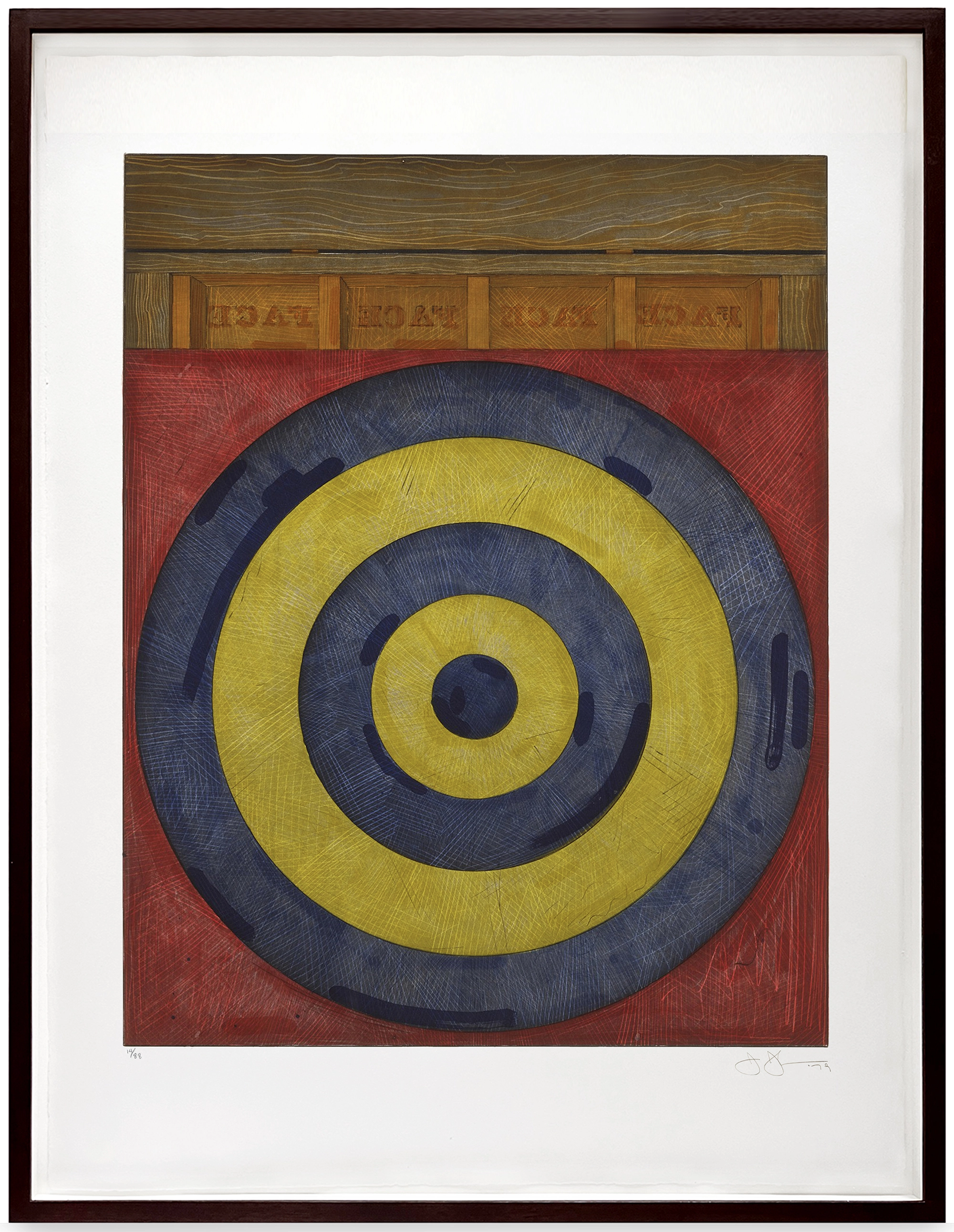
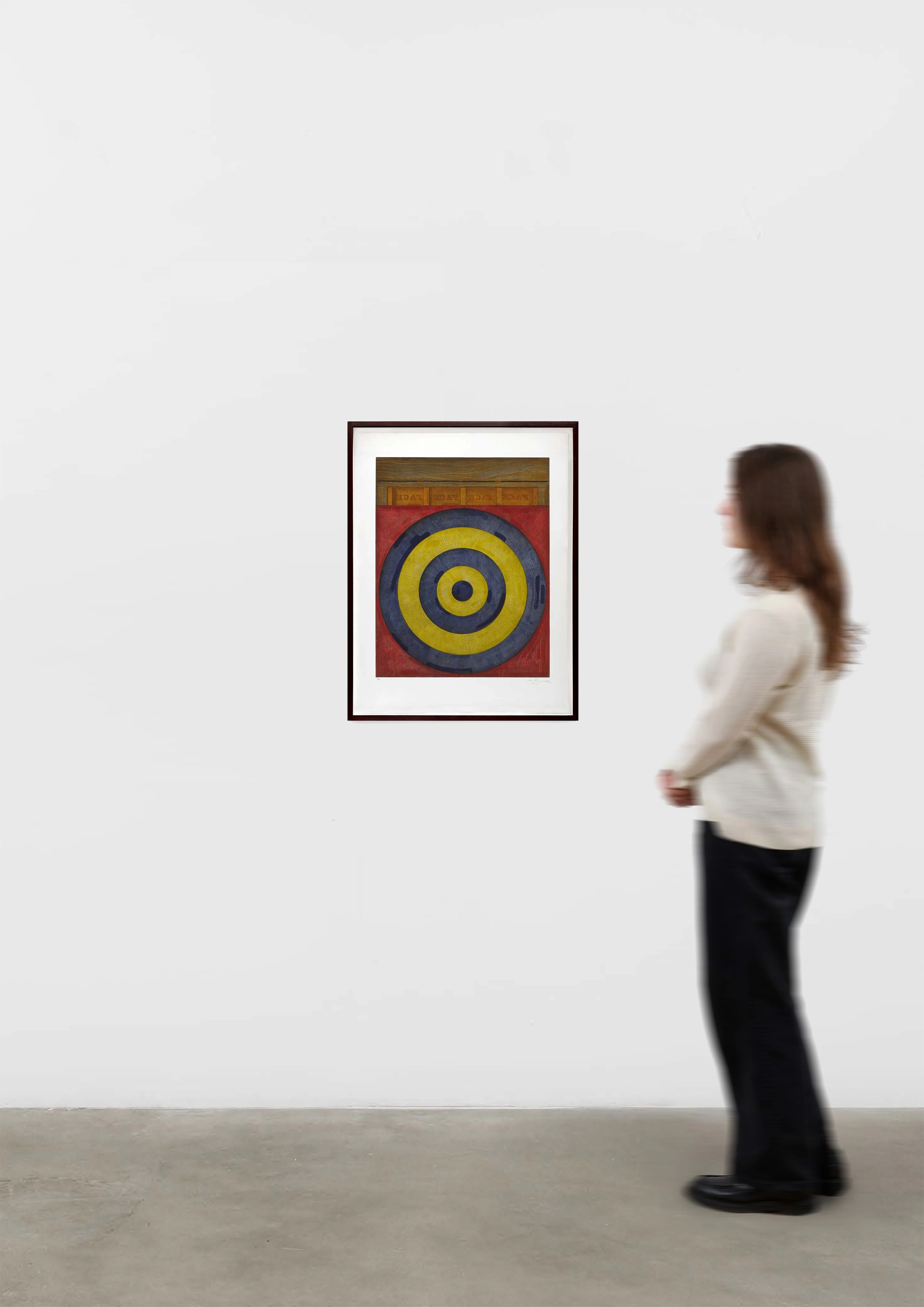
Target with Four Faces
(ULAE 203), 1979
paper: 29 7/8 x 22 1/8 inches
image: 23 1/2 x 18 1/4 inches
frame: 31 3/8 x 23 3/4 inches
edition: 88 with 13 AP's & 2 PP's
signed & dated in pencil "J Johns '79" lower right
numbered in pencil lower left
printed by Atelier Crommelynck
published by Petersburg Press, New York
© Jasper Johns / Licensed by VAGA at Artists Rights Society (ARS), NY
Literature
Judith Goldman, Jasper Johns Prints 1977-1981, Thomas Segal Gallery, Boston, MA, 1981, n.p., Segal 17, another impression reproduced full page black and white.
Richard Field, The Prints of Jasper Johns 1960-1993: A Catalogue Raisonne, ULAE, New York, 1994, Catalogue Reference ULAE 203, n.p., another impression reproduced in full-page color.
Carlos Basualdo, Scott Rothkopf, Jasper Johns Mind/Mirror, Whitney Museum of American Art, 2021, another impression reproduced plate 30, pg. 294.
Elizabeth Armstrong, Jasper Johns: Printed Symbols, Walker Art Center, 1990, pgs. 64-65, another impression reproduced in full-page color.
Exhibited
The Museum of Modern Art, New York, Jasper Johns: A Print Retrospective, May 19–Aug 19, 1986, another impression exhibited.
Walker Art Center, Minnesota, Jasper Johns: Printed Symbols, February 18-May 13, 1990, another impression exhibited.
The Museum of Fine Arts, Houston, Jasper Johns: Printed Symbols, June 17-August 19, 1990, another impression exhibited.
The Fine Arts Museums of San Francisco, San Francisco, Jasper Johns: Printed Symbols, September 15-November 18, 1990, another impression exhibited.
Montreal Museum of Art, Montreal, Jasper Johns: Printed Symbols, December 14, 1990-March 10, 1991, another impression exhibited.
Saint Louis Art Museum, St. Louis, Jasper Johns: Printed Symbols, April 6-May 27, 1991, another impression exhibited.
Center for the Fine Arts, Miami, Jasper Johns: Printed Symbols, June 22-August 18, 1991, another impression exhibited.
The Brooklyn Museum, Brooklyn, Jasper Johns: Printed Symbols, September 14-November 10, 1991, another impression exhibited.
Whitney Museum of American Art, New York, Jasper Johns Mind/Mirror, September 29, 2021-February 13, 2022, other impressions exhibited.
Powers Art Center, Carbondale, Jasper Johns: a whole can be only a part, December 2, 2025 – October 31, 2026, another impression exhibited.
Selected Museum Collections
Philadelphia Museum of Art, Philadelphia
National Gallery of Art, Australia
Los Angeles County Museum of Art, Los Angeles
Walker Art Center, Minneapolis
National Gallery of Art, Washington D.C. — includes eleven trial proofs, working proofs and state proofs of Target with Four Faces, 1979 by Jasper Johns
John and Kimiko Powers, Powers Art Center, Carbondale
Additional Photos
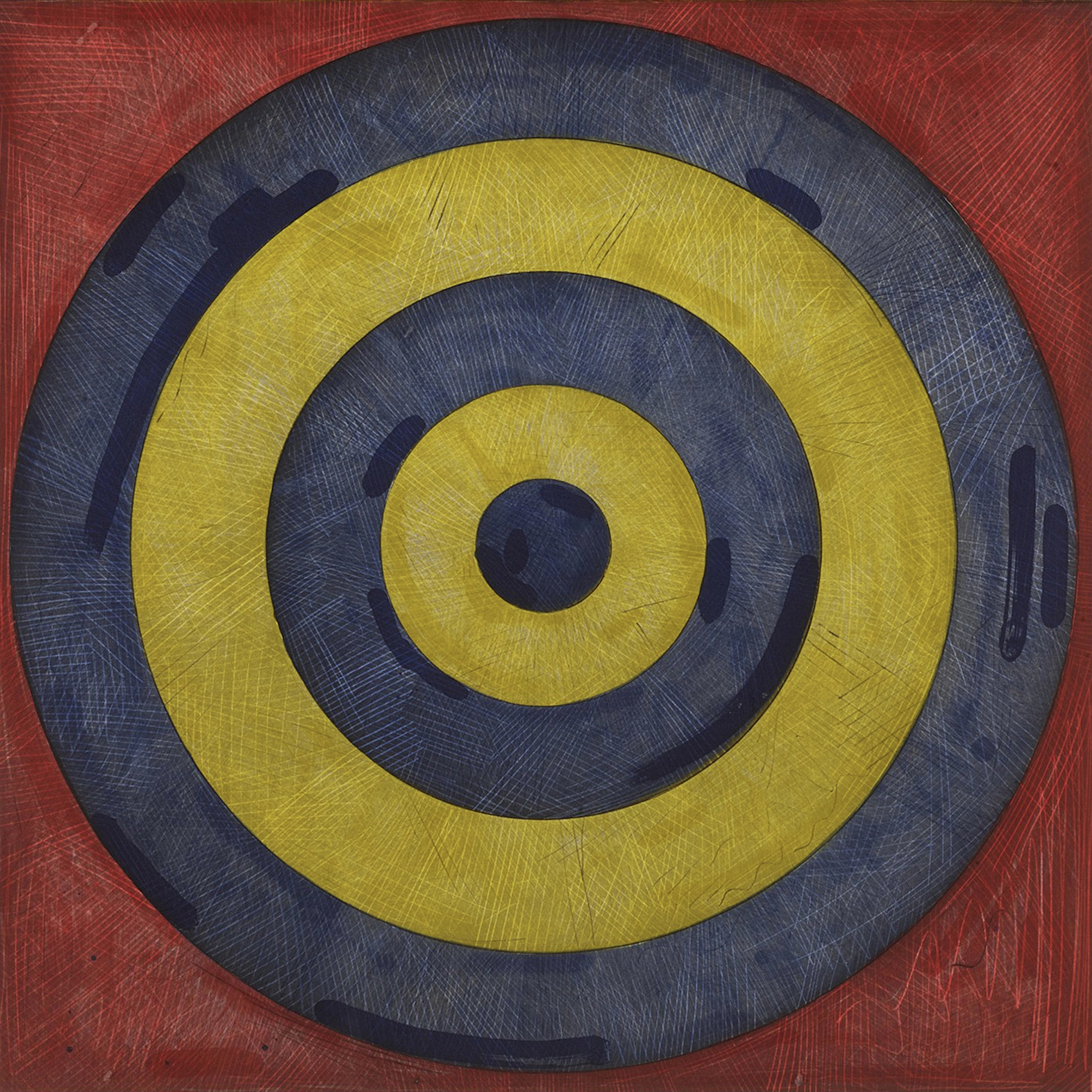
Image Detail
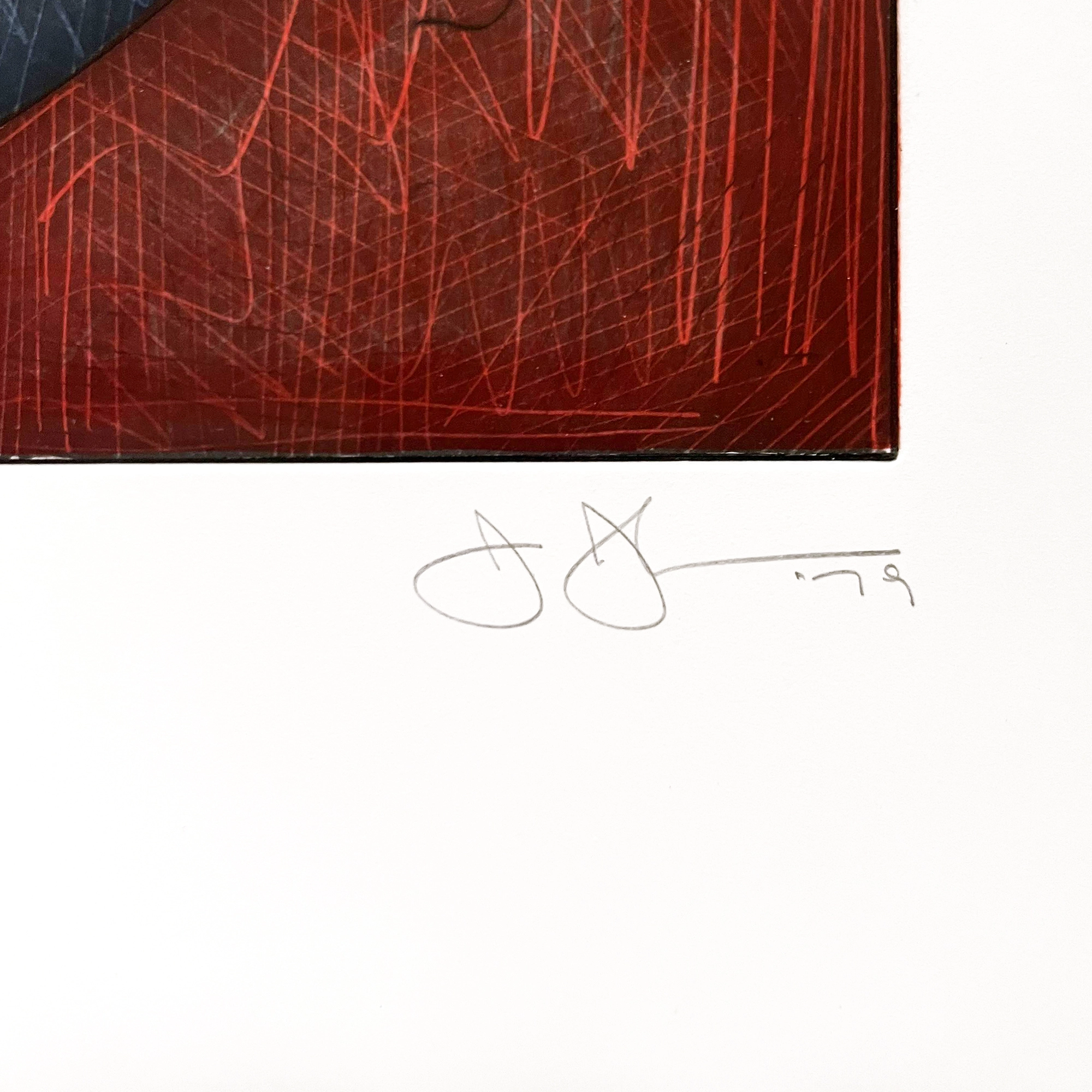
Signature & Date lower right
Jasper Johns, one of the most influential American artists of the 20th century, has been a master printmaker since the 1960s. Target with Four Faces (1978–1980), executed in color etching and aquatint, is one of two iconic Target prints Johns created in collaboration with master printer Aldo Crommelynck. Crommelynck—renowned for his work with Picasso, Braque, and Matisse—also brought his technical brilliance to Postwar and Contemporary artists such as David Hockney, Jim Dine, and Johns himself.
JASPER JOHNS TARGET WITH FOUR FACES
Jasper Johns, one of the most influential American artists of the 20th century, has been a master printmaker since the 1960s. Target with Four Faces (1978–1980), executed in color etching and aquatint, is one of two iconic Target prints Johns created in collaboration with master printer Aldo Crommelynck. Crommelynck—renowned for his work with Picasso, Braque, and Matisse—also brought his technical brilliance to Postwar and Contemporary artists such as David Hockney, Jim Dine, and Johns himself.
The Target motif has been central to Johns’ practice since the 1950s, when it first catapulted him to fame. Over the decades, the image has become a lasting emblem of his work—at once familiar and abstract, universal yet anonymous. Early works like Target with Plaster Casts and Target (1961, Art Institute of Chicago) established the motif in encaustic, a wax-based technique Johns used with meticulous precision. These Targets, like his Flags and Maps, have transcended their initial shock to become enduring icons of postwar American art.
Before Joseph K. Levene established Joseph K. Levene Fine Art, Ltd., he was President/COO, Petersburg Press, Inc. In 1989, Joseph K. Levene had the distinct privilege of selling the aforementioned Target, 1961, encaustic on canvas, to a private collector in Japan, who a decade later sold it to the late Stefan T. Edlis.
Renowned Jasper Johns expert Roberta Bernstein, a luminary in the field of art history and Professor Emeritus at the University of Albany, State University of New York, holds the mantle of the foremost scholar on Jasper Johns. Her authoritative monographs, including "Jasper Johns: Catalogue Raisonne of Painting and Sculpture," attest to her profound understanding of his art. Upon her initial encounter with Jasper Johns' "Flag and Target," Bernstein shared, "My trust in my perceptions was shaken up. This happened with the flags and targets that initially looked like the objects themselves and then became something else when looking at their surfaces."
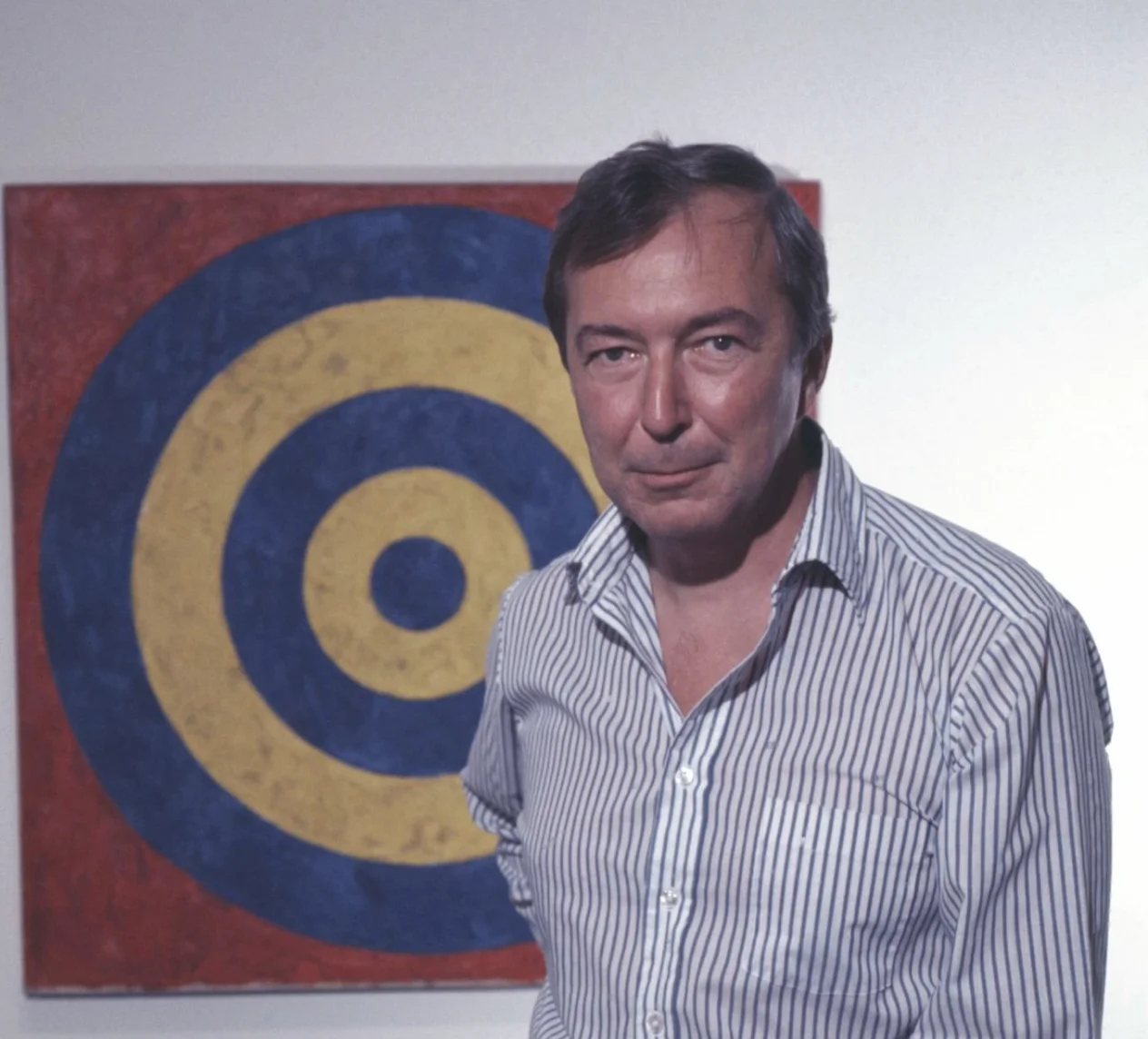
Jasper Johns’ work has been the subject of deep scholarly attention, particularly by Roberta Bernstein, Professor Emeritus at SUNY Albany and the foremost Johns expert. In her definitive catalogue raisonné, Bernstein recalls her early reaction to the artist’s Flags and Targets: “My trust in my perceptions was shaken up. This happened with the flags and targets that initially looked like the objects themselves and then became something else when looking at their surfaces.” Johns has often explained that his imagery comes from “things the mind already knows”—flags, targets, numbers, maps. Of these, the Target remains his most abstract and enigmatic, returning again and again in his oeuvre. It featured prominently in Jasper Johns: Mind/Mirror, the landmark retrospective jointly organized by the Whitney Museum of American Art and the Philadelphia Museum of Art.
Printmaking has played a vital role in Johns’ career, offering him a medium for continual reinvention. He has collaborated with many of the most celebrated print workshops of the 20th century, including Atelier Crommelynck, Petersburg Press, Gemini G.E.L., Universal Limited Art Editions, John Lund, Low Road Studios, and Simca Print Artists. These partnerships have been essential to the evolution of his art.
"Target" in its myriad iterations found a place of honor in Jasper Johns: Mind/Mirror, an expansive retrospective jointly organized by the Philadelphia Museum and the Whitney Museum of American Art. This monumental exhibition...
As Johns explained, the imagery derives from "things the mind already knows," utterly familiar icons such as Flags, Targets, Numbers and Maps. Of those four earliest icons that occupy his work, the Target is Johns' most abstract image, representing something anonymous and universal, the familiar target continues to appear in Johns' work.
The condition of Jasper Johns prints plays a pivotal role in preserving the integrity and value of these artworks. The presence of mat staining, fox marks and attenuated colors can significantly impact the overall aesthetic and historical integrity of these artworks. When considering a purchase of a Jasper Johns print, it is crucial to be wary of dealers who claim prints are in good condition despite such issues, as this may be a deliberate attempt to mislead buyers. Transparency is imperative in the art market and dealers who purposefully omit condition details are not acting in the best interest of the collector. It is also advisable to avoid dealers who artificially enhance colors in photos, distorting the true condition of the artwork. Choosing dealers who provide accurate representations, even if it reveals imperfections, ensures that buyers make well-informed decisions, maintaining the authenticity and value of Jasper Johns prints over time.