oil on canvas
35 x 45 3/4 inches
signed and dated ‘Miró. 1925.’ (lower right); signed and dated ‘Joan Miró 1925. 14/IX/64’ (on the reverse)
Provenance
Galerie Pierre, Paris
René Gaffé, Brussels
Roland Penrose, London, by whom acquired from the above in 1936 until at least 1973
Xavier Fourcade Inc., New York
E.V. Thaw & Co., New York
John Russell & Rosamond Bernier, by whom acquired from the above circa 1975
Christie’s, New York, 1 November 2005, lot 51
Helly Nahmad Gallery, New York
Private collection, New York
Joseph K. Levene Fine Art, Ltd., New York
Private Collection, New York
Christie’s, Londom, 27 February 2018, lot 123
Literature J. Dupin & A. Lelong-Mainaud, Joan Miró, Catalogue raisonné, Paris, 1999, vol. I, 1908-1930, no. 154, p. 129 (illustrated).
Exhibitions
New York, The Solomon R. Guggenheim Museum, Joan Miró: Magnetic Fields, October 1972 - January 1973, no. 7, p. 84 (illustrated).
Dusseldorf, Städtische Kunsthalle, Ausstellung Surrealität- Bildrealität, December 1974 - February 1975, no. 236.
Cleveland, Cleveland Museum of Art, The Spirit of Surrealism, October - November 1979, no. 26, pp. 75 & 174 (illustrated p. 74).
‘For me, a painting must give off sparks. It must dazzle like the beauty of a woman or a poem. It must radiate like the flints that shepherds in the Pyrenees use for lighting their pipes’ — Joan Miró
Joan Miró
‘In matters of love you have kept in line with the masters’
‘For me, a painting must give off sparks. It must dazzle like the beauty of a woman or a poem. It must radiate like the flints that shepherds in the Pyrenees use for lighting their pipes’ — Joan Miró
‘When the starting point of a work is to some extent the real world, I always write a title on the back of the canvas with my name and the date. For those conceived out of the void, I never put a title’ — Joan Miró
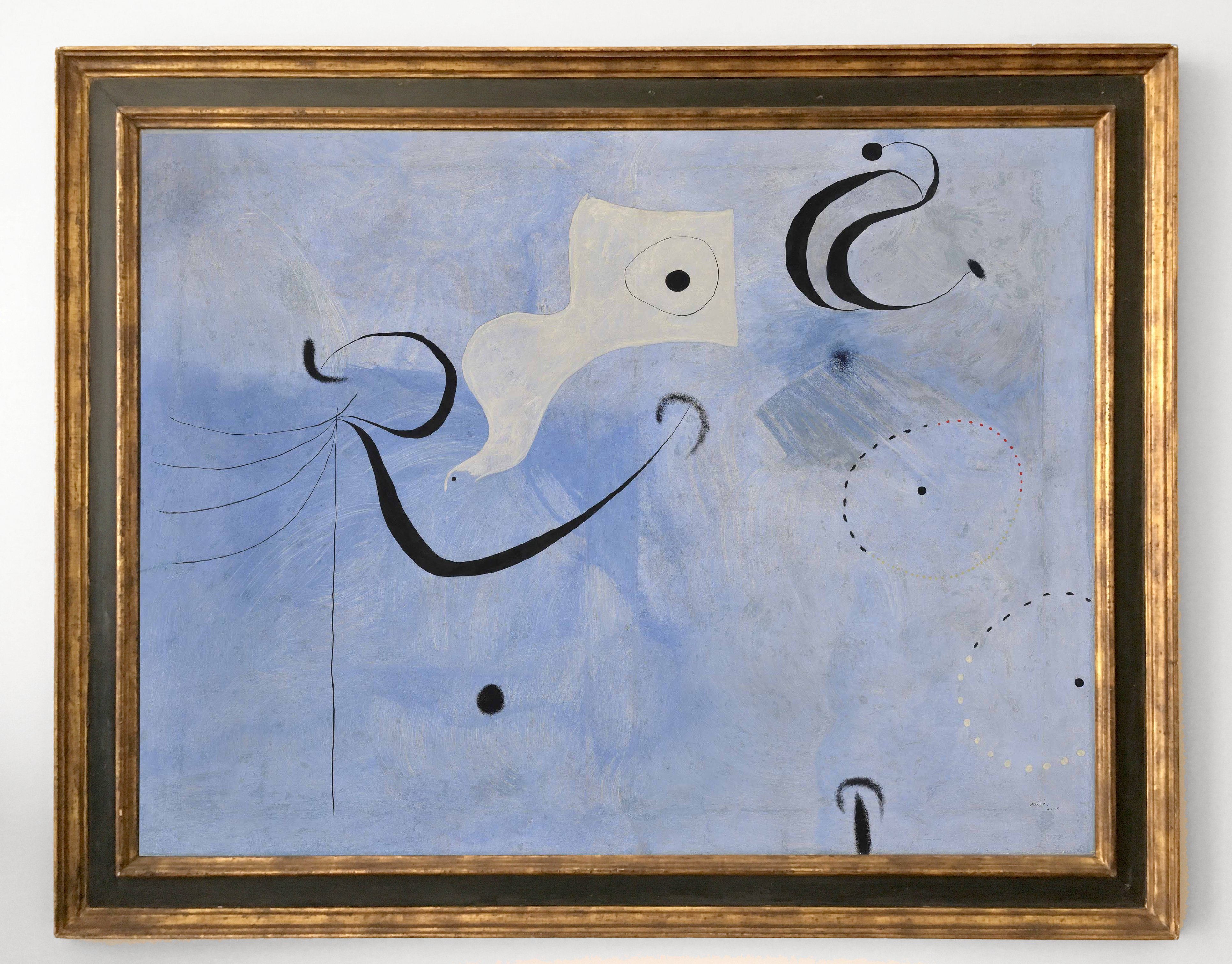
Filled with an ethereal, mysterious array of forms set against an impenetrable blue void, Joan Miró’s *Painting* dates from the early stages of the artist’s remarkable series of ‘oneiric’ or ‘dream’ pictures. In these radically simplified compositions where lines, cipher-like forms and spectral shapes are suspended upon brushed, monochromatic grounds, Miró succeeded in liberating his art from Western pictorial conventions of illusionistic representation and resemblance. These enigmatic works first emerged in the immediate aftermath of the artist’s inaugural solo exhibition at the Galerie Pierre in June 1925, and represent a decisive shift in Miró’s artistic output. Turning away from the densely packed compositions of paintings such as *Carnaval d'Arlequin*, which comprised teeming inventories of figures and objects excerpted from daily life, the artist focused instead on a simplified aesthetic, creating diaphanous forms and otherworldly spaces plucked from the depths of his imagination.
Symbolist and Surrealist poetry, the antics of Dada artists, the paintings of Paul Klee and, according to the artist himself, hallucinatory visions induced by hunger, were among the many stimuli that led to the invention of these paintings. Their deceptive simplicity proved shocking to audiences in the 1920s, who had grown accustomed to expecting some measure of formal complexity in modern painting. Nearly a century later, they remain among the most radical works in Miró’s oeuvre. The imagery continues to resist fixed interpretation, while the austere, minimalist aesthetic of the dream paintings still surprises and confounds viewers today.
Although Miró worked on the majority of the dream paintings in his family home in Montroig, Catalonia, their foundations lay in the extraordinarily stimulating environment of 45 rue Blomet in Paris, where the artist lived and worked from 1921 to early 1926. There, Symbolist poets and writers associated with the nascent Surrealist movement gathered in the studio of the painter André Masson, a close friend and neighbour of Miró. Through these encounters, Miró “gorged on poetry” and discovered automatic drawing, a technique then being explored by Masson and promoted by André Breton in his *Manifeste du Surréalisme* of 1924.
Inspired by these revelatory ideas, Miró no longer found it necessary to identify objects as translations of things seen and known. Instead, he sought to reveal deeper realms of consciousness where the unknowable and invisible suddenly flashed into awareness, leaving only traces beyond rational explanation. This was the primordial sphere of the subconscious to which Miró and his Surrealist contemporaries now laid claim as the source of artistic creation.
Writing about the dream paintings, the critic Jacques Dupin observed that these works were not merely depictions of dreams, but manifestations of psychic agitation and inner transformation. Pulsing monochromatic spaces become organic environments in which forms oscillate, intertwine, dissolve and re-emerge, charged with erotic fantasy, primitive urges and cosmic energy.
The forms that populate Miró’s dream paintings were derived from ambiguous and often hallucinatory images that the artist meticulously recorded in notebooks kept in his studio. As Miró later recalled, he would return home to the rue Blomet, often hungry, and see forms emerging from cracks in the walls and ceiling. Despite their apparent spontaneity, the paintings were the result of careful preparation intended to allow the artist’s internal impulses to flow freely onto the canvas. As Dupin noted, Miró’s method was not pure automatism, but a disciplined surrender to subconscious movement.
Miró himself later described this process as the emergence of “the signs of an imaginary writing.” Painting without premeditation, as if under the influence of a dream, he combined reality and mystery within liberated space. Fascinated by emptiness and the magnetic pull of the void, he transformed pale scumbled grounds into atmospheric fields upon which his dream-signs could unfold.
Miró painted *The Birth of the World*, perhaps the most celebrated of his dream pictures, in the late summer and fall of 1925. The present work likely followed soon afterward and contains many of the defining characteristics of the series. Forms are intentionally left ambiguous and lyrically evocative. A white, wraithlike spirit sails across the blue expanse, while flowing black contours suggest the beginnings of cursive letters or pictographic signs. Circular dotted forms at lower right may evoke a pair of eyes — perhaps the artist’s own inner gaze.
The monochrome blue abyss from which these forms emerge originated in a series of empty-ground canvases painted by Miró in 1923 and 1924, in which he stripped away extraneous painterly detail. In the dream paintings these grounds become expansive psychological spaces filled with strange gravity and light. While some oneiric compositions employ nocturnal darkness, many of Miró’s most evocative dream paintings are rendered in pale blue tones. His preference for this tranquil, introspective colour is reinforced by the inscription beneath a spot of blue paint in one of his peinture-poésies of 1925: “ceci est la couleur de mes rêves” (“this is the colour of my dreams”).
The cerulean tones of the present work recall the sky above Montroig, the Catalan landscape that nourished Miró’s imagination throughout his life.
The painting also possesses an exceptional provenance and a remarkable later history involving the artist himself. The first owner was Miró’s early patron and collector René Gaffé, who assembled one of the most important groups of early Miró works, including *Carnaval d'Arlequin* and *The Birth of the World*. Gaffé later sold *Painting* to Roland Penrose, Miró’s friend and early biographer, in 1936.
Nearly three decades later, in 1964, Penrose invited Miró to his home in Sussex while the artist was in London for a retrospective at the Tate Gallery. Delighted to encounter the painting again, Miró asked for it to be removed from its frame and proceeded to add several subtle pictographic elements directly onto the composition: comma-like strokes, additional markings and a bird-like symbol in flight. A photograph taken by Antony Penrose captures the moment, showing Miró painting once more upon the canvas after nearly forty years. These additions merge seamlessly into the composition and stand as a testament to the inexhaustible inventiveness of Miró’s imagination.