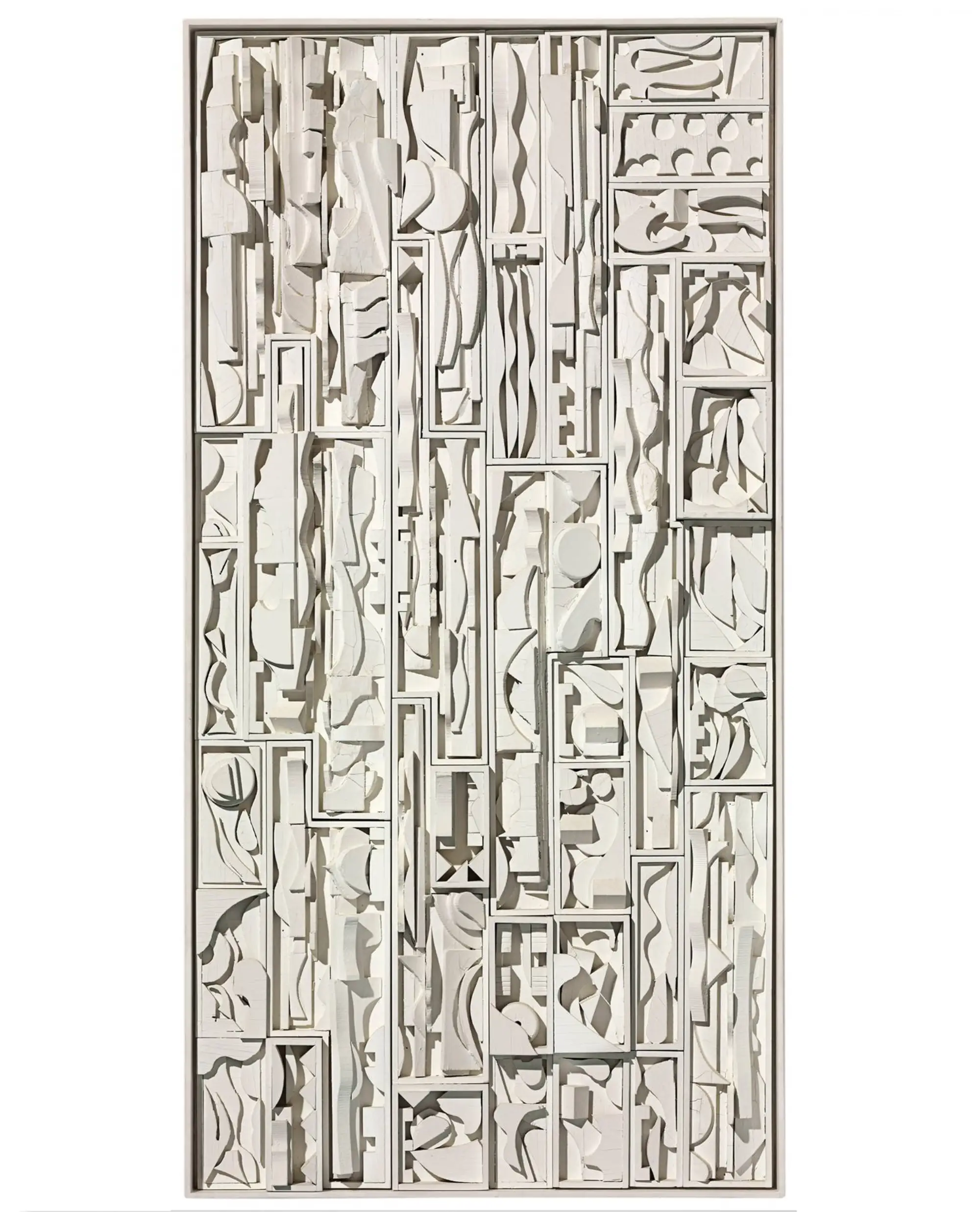
Maquette for White Vertical Water, 1972
36 5/8 x 18 5/8 x 2 3/8 inches
maquette for White Vertical Water, owned by the Solomon R. Guggenheim Museum.
Provenance
Commissioned from the artist and Pace Gallery, New York, 1972
Mr. & Mrs. James J. Shapiro, acquired from the above
Thence by decent
George T. Lund and Paula Shapiro Lund, West Palm Beach
Christie's, New York, September 27, 2018, lot 28
Joseph K. Levene Fine Art, Ltd., New York
Private Collection
Exhibitions
New York, Solomon R. Guggenheim Museum, Fifty Years of Collecting: An Anniversary Selection, Sculpture of the Modern Era, November 1987-March 1988.
Louise Nevelson’s monochrome sculptural environments use black and white as transformative forces—shifting perception, compressing or expanding space, and turning assemblage into psychological architecture.
LOUISE NEVELSON
Louise Nevelson: Black, White, and the Architecture of Space
In reflecting on her practice, Louise Nevelson once observed: “If you paint a thing black or you paint a thing white, it takes on a whole different dimension.” This statement offers not only an insight into her formal decisions, but a key to understanding the metaphysical ambition of her work. For Nevelson, color was never merely aesthetic—it was transformative, a means of reconfiguring perception, space, and even the psychological state of the viewer.
Nevelson’s sculptural environments—assembled from found wood and unified through monochrome—operate at the threshold between object and cosmos. Her use of black, which she described as containing “the silhouette, the essence of the universe,” compresses form into a kind of totality. In her black works, individual components dissolve into a unified field, where shadow becomes substance and structure becomes archetype. These constructions evoke a sense of containment, as though the vastness of existence has been distilled into a single, impenetrable surface.
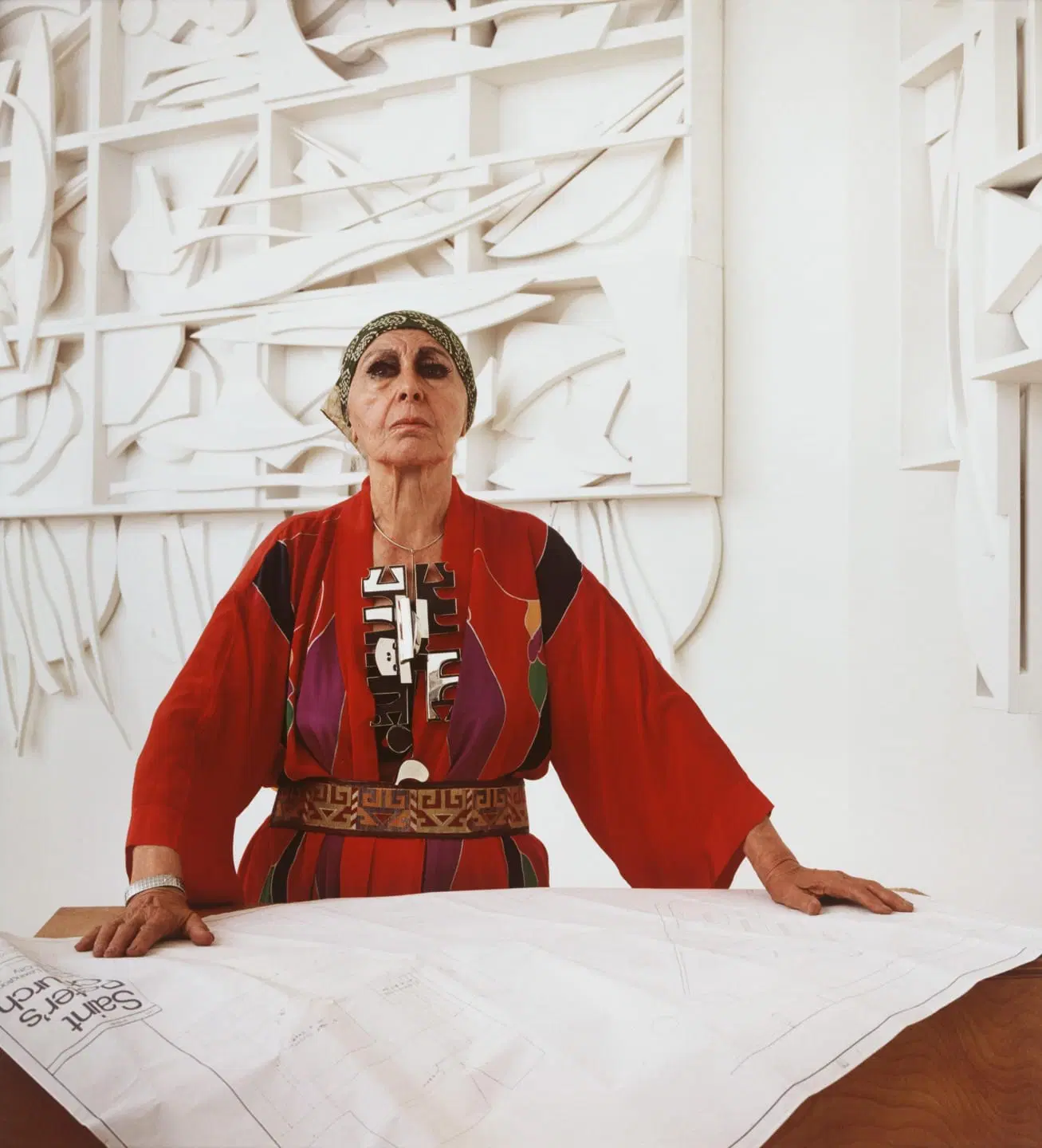
By contrast, her white works expand outward. As Nevelson suggests, “the white has more freedom, it moves out a little bit into outer space.” In these sculptures, light becomes an active participant. Edges sharpen, volumes separate, and the interplay of form and void becomes more legible. White introduces a sense of permeability—a suggestion that the work is not closed, but open to atmosphere, to light, to the viewer’s own projection. Where black absorbs, white releases.
This distinction is vividly embodied in Maquette for White Vertical Water, a 1972 painted wood construction that serves as a study for a larger sculptural environment. Here, Nevelson’s commitment to white transforms an assemblage of disparate elements into a unified yet dynamic field. The compartments and protrusions, characteristic of her practice, no longer recede into shadow but instead assert themselves through subtle variations of light. The work seems to hover between solidity and dissolution, its structure simultaneously grounded and atmospheric. As noted in the Christie’s lot essay, Nevelson’s own words accompany the work, reinforcing how central this philosophy of color was to her thinking.
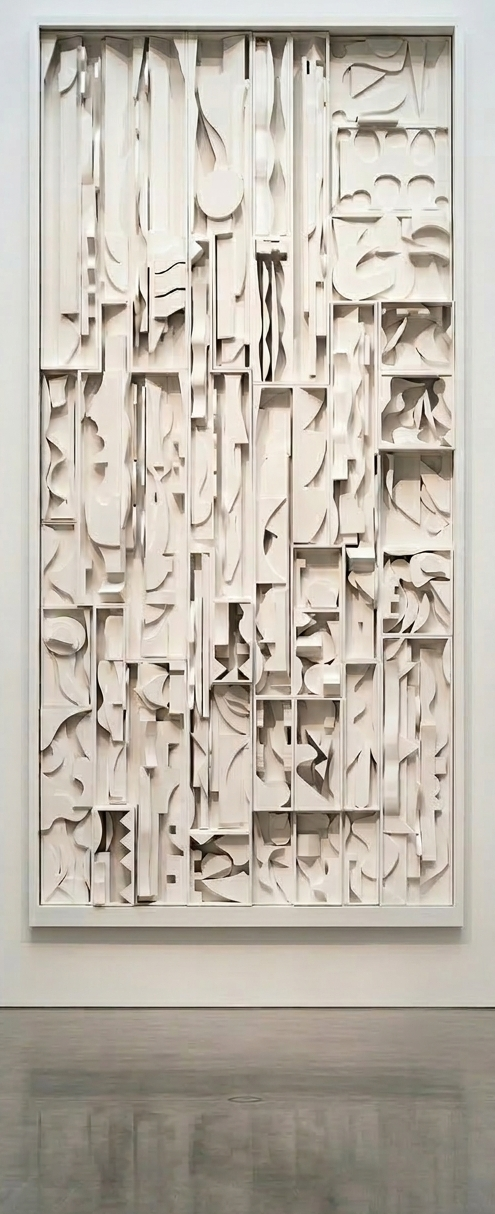
What emerges in this piece—and in her broader body of work—is a tension between containment and expansion, between interiority and the infinite. Nevelson’s sculptures are often described as architectural, yet they resist inhabitation in any conventional sense. Instead, they function as psychological or cosmic spaces, inviting contemplation rather than occupation. The shift from black to white marks not just a formal evolution, but a conceptual one: from enclosure toward openness, from the essence of the universe to its unfolding.
Ultimately, Nevelson’s insight that color can alter “a state of mind” underscores the experiential dimension of her work. Her sculptures are not static objects but active environments, shaping perception and emotion through their manipulation of light, shadow, and form. In both black and white, Nevelson constructs not just compositions, but worlds—each defined by its own logic, its own atmosphere, and its own relationship to the vast, unknowable space beyond.


