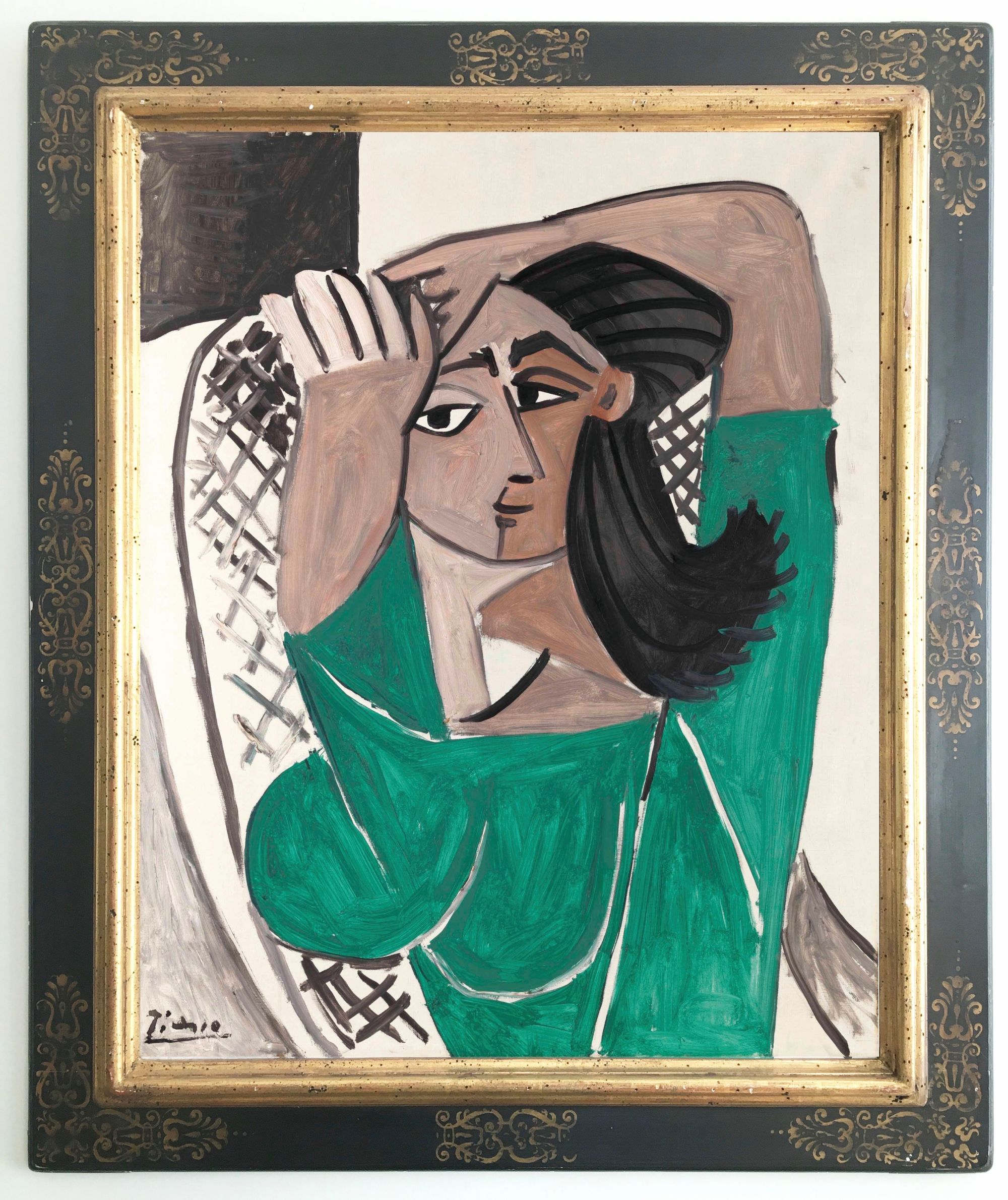
oil on canvas
32 x 25 3/4 inches
signed ‘Picasso’ (lower left); dated and numbered ‘3.1.56. II’ (on the reverse)
Painted on 3 January 1956
Provenance
Galerie Louise Leiris, Paris (no. 07162)
Galeria Maison Bernard, Caracas
Ruth & Mauricio Kramer, Sotheby’s, New York, 16 November 1989, lot 348
Christie’s, New York, 19 November 1998, lot 347
Private collection, United States
Christie’s, New York, 2 May 2006, lot 45
Acquired at the above sale, and thence by descent
Joseph K. Levene Fine Art, Ltd., New York
Private Collection, New York
Christie’s, London, 27 February 2018, lot 9
Literature C. Zervos, Pablo Picasso, vol. 17, Oeuvres de 1956 à 1957, Paris, 1966, no. 3, n.p. (illustrated pl. 3).
‘In matters of love you have kept in line with the masters’
Languidly reclining on a wicker chair, her arms stretched above her head in a pose of seductive insouciance, Jacqueline Roque—the last great love of Pablo Picasso’s life—emerges as the central figure in *Femme se coiffant*. Painted on 3 January 1956, less than two years into their relationship, the work belongs to a sequence in which the artist returned repeatedly to this classically inflected pose, depicting Jacqueline as she arranges her hair.
PABLO PICASSO
‘In matters of love you have kept in line with the masters’
(Georges Braque, quoted in A. Danchev, *Georges Braque: A Life*, New York, 2005, p. 233)
‘She has within her that wonderful power on which the painter feeds. She flows. She is made for it and gives of herself and devotes herself and dies in harness though living all the while and never posing. She harbours that multiplicity of herself... She unfurls ad infinitum. She invades everything. She becomes all characters. She takes the place of all models of all the artists on all the canvases. All the portraits resemble her, even though they may not resemble each other. All the heads are hers and there are a thousand different ones’
(Hélène Parmelin, *Picasso: Intimate Secrets of a Studio at Notre Dame de Vie*, New York, 1966, pp. 14–15)
‘They lived in a world of his own creation
where he reigned almost as a king
yet cherished only two treasures –
freedom to work and the love of Jacqueline’
(David Douglas Duncan, *Picasso and Jacqueline*, New York, 1988, p. 9)
Languidly reclining on a wicker chair, her arms stretched above her head in a pose of seductive insouciance, Jacqueline Roque—the last great love of Pablo Picasso’s life—emerges as the central figure in *Femme se coiffant*. Painted on 3 January 1956, less than two years into their relationship, the work belongs to a sequence in which the artist returned repeatedly to this classically inflected pose, depicting Jacqueline as she arranges her hair. Here, however, her presence is charged with a deliberate allure, suffused with sensuality as she engages the gaze of her devoted observer.
Among the earliest expressions of what has come to be known as *L’Époque Jacqueline*, this painting introduces visual elements that would recur throughout Picasso’s late work. Jacqueline’s raven hair, almond-shaped eyes, and elegant, aquiline profile became defining features across an extensive body of portraits. Her presence permeated the artist’s output with remarkable consistency—her image serving not merely as subject, but as a structural and emotional constant within his practice.
Picasso first encountered Jacqueline in 1952 at the Madoura ceramics studio in Vallauris, where she was working at the time. Their relationship developed over the following years, and by 1954 she had become a central figure in his life and art. From that moment onward, her likeness appeared with increasing frequency, marking the beginning of an enduring and deeply intertwined partnership. After the death of his first wife, Olga, the couple married in 1961. Jacqueline would remain a steadfast presence—companion, confidante, and muse—throughout the final decades of the artist’s life.
In 1955, they moved to La Californie, a spacious villa in Cannes that became both home and studio. The interiors of this residence—filled with artworks, objects, and distinctive furnishings—appear throughout Picasso’s paintings of the period. The wicker chair featured in *Femme se coiffant* reflects this environment, grounding the composition in the lived reality of the artist’s surroundings while also functioning as a formal device within the image.
The motif of the woman arranging her hair carries a long lineage in Western art, tracing back to classical antiquity and the lost compositions attributed to Apelles. It was later revisited by artists such as Titian, Jean-Auguste-Dominique Ingres, Edgar Degas, and Pierre-Auguste Renoir, each exploring the intimate ritual of toilette within their own visual language. Picasso himself had engaged with this theme earlier in his career, notably in works from Gósol in 1906 and in the seminal *Les Demoiselles d’Avignon* (1907), where the raised-arm pose becomes a declaration of assertive presence and autonomy.
The seated female figure, rendered with both intimacy and monumentality, also recalls the work of Henri Matisse, whose influence remained deeply felt in Picasso’s later years. Following Matisse’s death in 1954, Picasso engaged in a series of works that can be understood, in part, as reflections on and responses to his longtime peer. The interplay of line, flattened space, and pattern in *Femme se coiffant* echoes this dialogue, while remaining firmly rooted in Picasso’s own evolving visual language.
In this work, Jacqueline appears at once timeless and immediate—both an individual presence and a vessel for a broader artistic tradition. Her poised, self-contained figure anchors the composition, embodying a synthesis of intimacy, history, and reinvention that defines Picasso’s late practice.